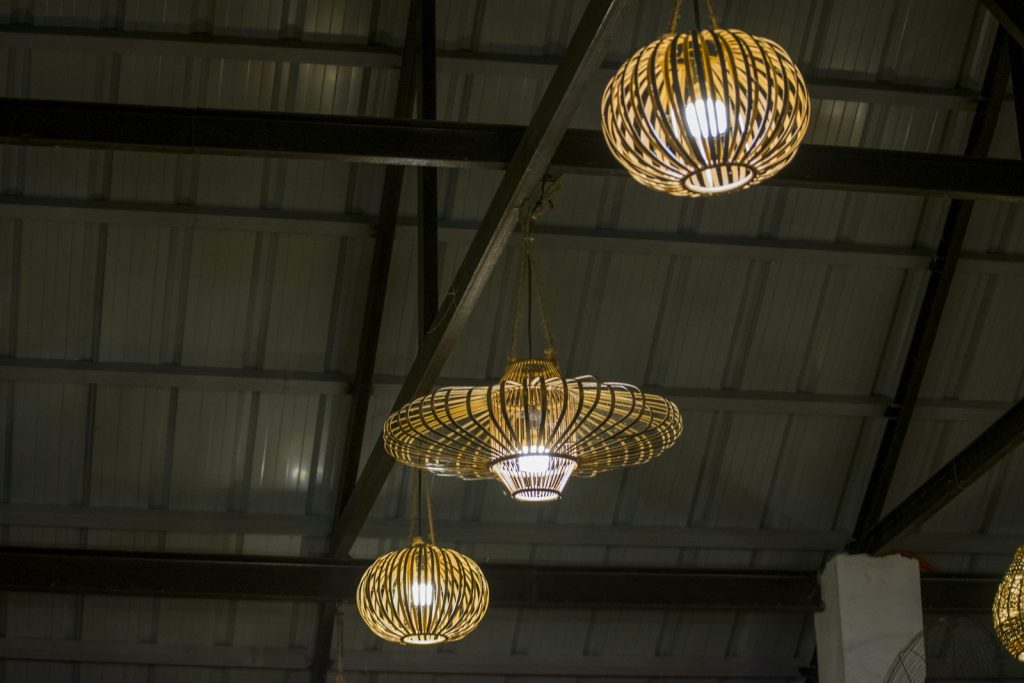
Honest buyer note: Our lamps are handwoven by village artisans in Bali and Java, so expect natural colour variation and a size tolerance of roughly ±1–3 cm on larger shades. All prices, MOQs, lead times and container counts are indicative ranges (2024–2025, FOB Indonesia) and final pricing is by quote. Standard wiring is E27 at 220–240 V; we can supply CE-compliant wiring or shade-only (no electrics) so you meet UL/UKCA or local standards in your market — we don’t imply certification we don’t hold. Natural fibre is moisture-sensitive, so we dry, treat and pack appropriately and recommend acclimatisation on arrival. Rattan is generally not CITES-listed. We coordinate vetted workshops and handle export documentation.
Rattan vs bamboo vs seagrass lighting is really a question of structure, behavior and risk: rattan for strength and longevity, bamboo for bold lines, seagrass for soft texture and price. In this guide I’ll compare these three natural fibres the way buyers actually need — by weave, durability, light effect, FOB range, MOQ and export practicalities from Bali and Java.
Rattan vs Bamboo vs Seagrass Lighting: Clear Definitions First
To make a useful natural fibre lamp comparison, we need to be precise about what each material is in the export context from Indonesia.
What is rattan in lighting?
Rattan is a solid climbing palm (not a hollow grass) sourced mainly from Kalimantan and Sulawesi, then peeled, split, and woven in Bali and Cirebon (Java). For lamps we typically use:
- Core rattan – solid round poles, 3–12 mm for frames and ribs.
- Rattan peel – thin outer skin strips for tight weaving and bindings.
- Manau and sega species – common for stronger frames and larger pendants.
Rattan is naturally strong and springy, so we can build large open pendants and chandeliers without heavy metal frames. Most export rattan species used in lamps are not CITES-listed in 2024–2025, so we ship under standard HS codes for rattan furniture and lighting components (e.g. HS 9405.x combined with rattan material declarations), not endangered-species permits.
What is bamboo in lighting?
Bamboo is a hollow grass, usually from Java, cut into poles and split into strips. For lighting we use:
- Bamboo poles – for bold ring frames or vertical ribs.
- Split bamboo – 5–20 mm wide strips, shaved smooth, for woven shades.
- Bamboo ply or slats – machine-cut flat profiles for contemporary forms.
Bamboo is stiffer in short lengths but more brittle over time than rattan if not treated well. It gives a cleaner, more architectural line but needs careful drying and finishing to avoid cracking.
What is seagrass in lighting?
“Seagrass” in export lighting is usually dried coastal grass rope (sometimes with a cotton core) woven over a rattan or metal frame. It is:
- Softer and more fibrous than rattan or bamboo.
- More moisture-sensitive, with higher mould risk in humid storage.
- Almost always an outer wrap, not the structural frame material.
Seagrass gives that thick, handwoven rope look that many hospitality and retail clients like for beach and resort projects, but it is the least dimensionally stable of the three.
How Each Material Is Actually Woven in Bali & Java
Material choice is only half the story. Weave type + structure matter just as much for performance.
Rattan weaving for lighting
- Open lattice frames – round cores bent over a simple jig, bound with peel at each crossing. Used for popular bell and dome pendants in 30–60 cm diameters.
- Tight wicker shades – small-gauge core (2–3 mm) or split rattan woven over a fixed mould, peels used for decorative patterns (diamond, hex, caning styles).
- Steam-bent shapes – thicker rattan steamed, bent, then dried in jigs for curves (teardrops, gourds, hourglass). The frame is then skinned with peel or left open.
On the ground, one medium dome pendant (Ø40 cm) might take a Balinese or Cirebon weaver 2–3 hours from prepared frame to finished piece, excluding drying and finishing. That labor reality is why rattan is the workhorse material: it bends predictably and holds tension, reducing rejects.
Bamboo weaving for lighting
- Strip-weave drums and cylinders – bamboo strips woven like a basket over a fixed cylindrical jig, then edge-bound with rattan or bamboo rings.
- Slatted lanterns – straight bamboo slats fixed to top and bottom hoops, creating vertical lines and strong shadow patterns.
- Layered “cage” pendants – concentric bamboo rings or cages, usually with some rattan binding for strength.
Bamboo weaving in Cirebon workshops is usually more jig- and machine-assisted than rattan. Strips are cut to consistent width with table saws, then hand-assembled. This gives more regularity in modern shapes but still carries handmade variance in strip spacing and curves.
Seagrass weaving for lighting
- Rope-wrapped frames – rattan or metal frames fully wrapped in seagrass rope, row by row, for thick, fabric-like surfaces.
- Open spiral wraps – seagrass rope wound around a frame with intentional gaps to let more light through.
- Mixed-fibre weaves – seagrass combined with cotton or abaca twine for pattern and some stability.
In Bali, most seagrass lamp work is done in small home workshops: frames arrive from Cirebon or local metal shops, then are hand-wrapped. Production speed is slower and more variable than open rattan lattice, which shows up in both cost and lead time for complex designs.
Natural Fibre Lamp Comparison: Performance & Aesthetics
For trade buyers, “which woven lamp material” mainly means: how will it behave for my client and how will it look over time?
Light diffusion & shadow
- Rattan: Most versatile. Tight wicker gives warm, gentle diffusion, almost like fabric. Open lattice creates clear shadow patterns and visible bulb; popular for hospitality bars and restaurants.
- Bamboo: Sharper, more graphic shadows due to flatter, wider strips. Slatted bamboo shades can create strong stripes on walls and tables — intentional in contemporary schemes, harsh in low ceilings.
- Seagrass: Heaviest diffusion. Thick rope wraps can block 40–60% of light output, good for ambience, not task lighting. Mixed weaves or looser spirals help gain light back.
Durability & movement
- Rattan: Best structural durability indoors. It flexes slightly with humidity changes and returns to shape. Properly dried and sealed, a rattan pendant can sit in an air‑conditioned retail space or restaurant for years with minimal cracking.
- Bamboo: Higher risk of hairline cracks at nodes and edges over time, especially under strong air‑conditioning or near windows with sun exposure. Stabilised by good sanding, anti‑split treatment and finishing coats.
- Seagrass: Fibres swell in humidity and relax in dry air, which can cause rope to loosen slightly or change texture. More sensitive to spills and stains in F&B areas.
Moisture & mould risk
All three materials are not suitable as exposed outdoor lamps in wet climates without significant modification. For covered terraces and high‑humidity destinations:
- Rattan: Medium risk. If packed or stored while damp, mould can develop on the surface. We kiln-dry and sun-dry before packing, but importers should still unpack quickly on arrival and avoid long, sealed storage in humid warehouses.
- Bamboo: Similar mould risk, plus potential for powder beetle if not treated. Export-standard factories in Java apply anti-borer treatments.
- Seagrass: Highest mould risk. Dense rope retains moisture; poorly ventilated containers or damp retail storage can lead to odour and spotting. Seagrass buyers should be especially strict on drying, silica-gel use and warehouse conditions.
Pricing, MOQs & Logistics: Rattan vs Bamboo vs Seagrass Lamps
The numbers below are indicative 2024–2025 FOB Java/Bali ranges, not fixed offers. Final quotes depend on design, size mix, packing spec and loading plan. All pricing is by formal quote only.
| Aspect | Rattan Lighting | Bamboo Lighting | Seagrass Lighting |
|---|---|---|---|
| Typical FOB range (pendant Ø30–50 cm)* | ~US$8–22 per piece | ~US$7–20 per piece | ~US$9–24 per piece |
| MOQ (mixed models, same finish) | 150–300 pcs per order | 150–300 pcs per order | 120–250 pcs per order |
| 20’ container capacity (mixed pendants) | ~350–650 pcs depending on nesting | ~350–650 pcs depending on nesting | ~300–600 pcs (bulkier ropes) |
| 40’HC container capacity (mixed pendants) | ~750–1,400 pcs | ~750–1,400 pcs | ~700–1,300 pcs |
| Typical lead time (post-deposit) | 8–12 weeks | 8–12 weeks | 10–14 weeks (more hand wrapping) |
| Best cost-efficiency | Medium–large open pendants | Medium drum/slat shapes | Medium shades in nested sets |
*FOB ranges last verified June 2026. Actual quotes vary by design complexity, finish system, packing spec and order mix.
All three materials are exported under the lighting HS category (e.g. HS 9405.x) with supporting material declarations (rattan, bamboo, seagrass). Some buyers prefer to import as “lamp shades only” with separate local wiring; others import lamps fully wired.
Wiring, Certification & Shade-Only Options
For rattan, bamboo and seagrass lighting, you have several options for electrics. We keep this straightforward and honest:
- Standard fitting: E27 lampholder, 220–240 V, suitable for EU/UK/AU markets in terms of base type.
- CE: We can supply CE-conform wiring sets from partner factories for EU-focused importers, but final conformity responsibility sits with the importer placing goods on the EU market.
- UL/ETL: Full UL certification for complete lamps is typically arranged by the buyer on arrival, or by using their own UL-listed wiring kits. We can supply shade-only (no wiring) for US and Canada so you fit your own certified kits.
- Shade-only for all markets: Common for large projects and retailers who want to standardise electrics. In this case we focus on frame stability, hanger strength and correct bulb clearance.
No natural fibre is inherently “certified”; only the electrical assembly can be. If you need FSC or PEFC claims on timber elements (e.g. wooden ceiling cups or accents), that requires specific certified supply chains and documentation — available only on request and not assumed by default.
If you need help aligning material choice with your certification route and import market, you can plan your trip to the right specification by sending us your brief via email or WhatsApp; we’ll respond with practical options and wiring configurations.
Design Use-Cases: Which Woven Lamp Material Fits Which Project?
Rattan: generalist for retail, hospitality & residential
Best for:
- Retail and e‑commerce collections needing a wide size and shape range.
- Hospitality projects requiring dozens to hundreds of matching pieces with reasonable uniformity.
- Custom development (OEM) of new forms — rattan tolerates prototyping and tweaking better than bamboo or seagrass.
Common rattan lamp types we export from Bali and Cirebon:
- Pendant domes and bells – Ø25–80 cm; open lattice or semi‑tight weaves.
- Drum and barrel shades – used over dining tables and counters; straight sides make carton packing efficient.
- Floor and table lamps – rattan shades on timber or metal bases, usually shipped KD (knock‑down) where possible.
- Wall sconces – half-dome or cylinder rattan shades mounted on metal/wooden brackets.
Bamboo: graphic lines for contemporary schemes
Best for:
- Modern interiors needing cleaner lines than classic rattan basket shapes.
- Projects where strong linear shadow is a design feature (bars, feature walls).
- Buyers targeting a lower price point per unit via more geometric, jig-based production.
Bamboo works particularly well in:
- Tiered lantern pendants – concentric bamboo rings for large foyers.
- Rectangular or square shades – slatted or panelled, often combined with fabric inner diffusers.
- Table lamps – structured cages over simple wooden or ceramic bases.
Seagrass: texture and warmth for relaxed spaces
Best for:
- Resort, beach club and coastal residential projects seeking strong tactile character.
- Accent lighting where heavy diffusion and a soft glow are acceptable.
- Retail collections targeting “boho” or coastal decor niches, with smaller volume per SKU.
Typical seagrass pieces leaving Bali workshops include:
- Rope-wrapped drum pendants – Ø30–50 cm, often in nested sets of three for container efficiency.
- Organic bell and onion forms – seagrass rope wrapped around rattan frames for irregular, hand‑made silhouettes.
- Small table lamp shades – seagrass outer, rattan frame, shipped shade-only or with simple E27 cord sets.
Handmade Variance: What to Expect, Material by Material
All Bali and Java woven lighting is hand-formed over jigs and moulds. Even with experienced weavers and QC, you should allow for:
- Size tolerance – usually ±1–2 cm on diameter/height for open weaves; sometimes up to ±3 cm for very large, organic shapes or seagrass wraps.
- Colour variation – natural rattan, bamboo and seagrass will vary shade from batch to batch; clear or tinted topcoats even this out but never fully standardise it.
- Pattern irregularity – slight differences in weave tightness, knot placement and rope twist are normal.
By material:
- Rattan: Most controllable variance. Open lattice pendants and drum shades from Cirebon can be held fairly close to samples with good QC.
- Bamboo: Strip width is machine-cut, so spacing is more regular; minor cracking is the variable to watch, managed via inspection and finishing.
- Seagrass: Highest visual variance; rope thickness and colour shift between batches and even between coils. Expect more character and less uniformity.
Finishes & Colours: What Each Material Accepts Well
- Rattan:
- Natural clear coat (matt/semi-matt).
- Light to dark stains (honey, walnut, espresso).
- Painted finishes (white, black, colour) – better on tight weaves and peel; open lattices show paint build-up if not sprayed correctly.
- Bamboo:
- Natural with clear coat – emphasises nodes and grain.
- Carbonised/heat-treated tones from Java suppliers.
- Opaque paints – acceptable but more prone to visible chips on edges.
- Seagrass:
- Mostly natural; clear protective sprays only.
- Light washes and subtle tints possible, but heavy paint kills the rope texture and can crack.
- Two-tone effects by mixing different rope batches or fibres.
If your brand requires a very specific Pantone or RAL in a painted finish, rattan or bamboo are better carriers than seagrass. For projects emphasising natural, low-sheen textures, all three can work, with seagrass giving the roughest hand feel.
Sustainability & Compliance Without Greenwashing
All three materials are fast-growing natural fibres, but that does not automatically make a lamp sustainable. For professional buyers:
- Rattan: Often positioned as a regenerative forest product, but real impact depends on local harvesting practices in Kalimantan and Sulawesi and on transport logistics. We do not make blanket “eco” claims; we can share supplier-level information on request.
- Bamboo: Rapid growth is an advantage, but treatment (boron, finishes) and end-of-life reality (mixed materials, wiring) still matter. There is no automatic “zero-impact” story.
- Seagrass: Coastal fibre with low initial processing, but higher loss rates from mould and damage can offset some benefits if storage and shipping are not well managed.
If you require FSC or PEFC for wooden elements, or specific environmental documentation for a project, this must be requested early in the specification process. Certified wood is possible, but the default supply is not certified.
Choosing Between Rattan, Bamboo & Seagrass for Your Next Order
A simple way to decide which woven lamp material to prioritise:
- Main priority is structural stability and long-term use in mixed interiors
- Choose rattan as your core line, with bamboo and seagrass as accents.
- Main priority is strong linear aesthetics and contemporary shadow patterns
- Lean into bamboo drums, slats and cages.
- Main priority is tactile, relaxed ambience with heavy diffusion
- Specify seagrass pendants and small shades, but plan for stricter storage and humidity control.
- Tight landed cost and high unit count in one container
- Focus on nested rattan or bamboo pendants in a compact shape family.
If you share your target market (EU/UK/US/AU), channel (retail, e‑com, hospitality) and price band, we can propose a material mix and weaving styles that fit, with MOQ and FOB ranges appropriate to your volumes. You can plan your trip from first idea to RFQ over email or WhatsApp; sending a photo moodboard or Pinterest link is enough to start.
FAQs: Rattan vs Bamboo vs Seagrass Lighting
Which material lasts the longest for indoor woven lamps?
For normal indoor use, rattan typically lasts the longest. It is structurally stronger and more flexible than bamboo, so it handles humidity and minor knocks better. Bamboo is durable if well treated but more prone to cracking over time. Seagrass is the most sensitive to moisture and wear; it is best considered a decorative, not lifetime, material.
Can rattan, bamboo or seagrass lamps be used outdoors?
Direct outdoor exposure is risky for all three. Under a fully covered, well-ventilated roof (no direct rain) rattan and bamboo can perform reasonably, but there will still be faster ageing and colour change. Seagrass outdoors is high risk for mould and fibre breakdown. For true exterior lighting, you should consider other materials or specialised constructions; our woven lamps are primarily for interior or covered use.
Which woven lamp material is cheapest per unit?
For comparable shapes and sizes, bamboo and rattan are usually close in FOB range, with bamboo sometimes slightly lower for simple, jig-based designs. Seagrass can be more expensive on a labour basis because rope wrapping is slower, and packing efficiency is lower. The most important cost drivers are design complexity, size, nesting efficiency and finish, not just the fibre itself.
What tolerances should I specify for handmade woven lighting?
We suggest you plan for ±1–2 cm on key dimensions and accept minor weave irregularities as part of the product character. For large organic seagrass or rattan pieces, ±3 cm can be realistic. If you require tighter tolerances for a specific installation (e.g. a row of pendants over a bar), we can adjust jigging and QC accordingly, but some variance will always remain.
Can you match my brand’s exact colour or finish?
We can get close to most reference colours using stains and paints on rattan and bamboo, and to a lesser extent on seagrass. Natural fibres always introduce variation: two batches will never be perfectly identical. For critical brand colours, we recommend approving physical samples, accepting a tolerance band, and sticking to one material and weave type across the collection for consistency.