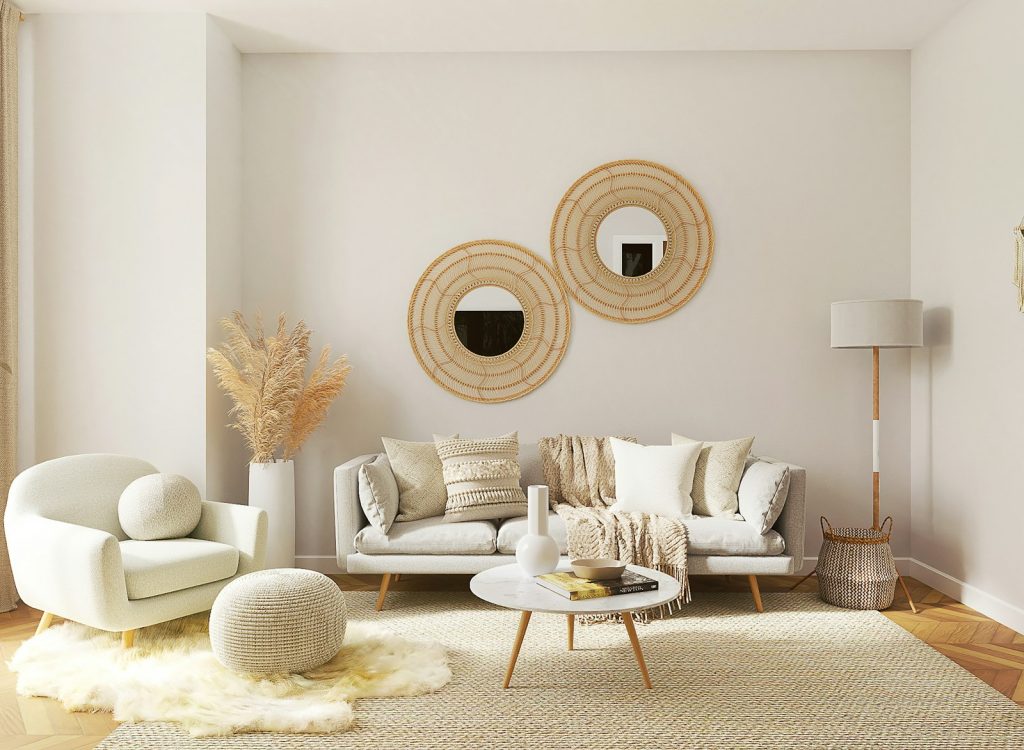
Honest buyer note: Our lamps are handwoven by village artisans in Bali and Java, so expect natural colour variation and a size tolerance of roughly ±1–3 cm on larger shades. All prices, MOQs, lead times and container counts are indicative ranges (2024–2025, FOB Indonesia) and final pricing is by quote. Standard wiring is E27 at 220–240 V; we can supply CE-compliant wiring or shade-only (no electrics) so you meet UL/UKCA or local standards in your market — we don’t imply certification we don’t hold. Natural fibre is moisture-sensitive, so we dry, treat and pack appropriately and recommend acclimatisation on arrival. Rattan is generally not CITES-listed. We coordinate vetted workshops and handle export documentation.
Rattan lighting interior designers choose for projects is simply natural-fiber lighting—pendants, floor, table and wall lamps—specified with reliable data on weave, sizing, FOB ranges and lead times. This page is the straight B2B answer: how we actually produce and ship interior designer rattan lighting from Bali and Java, and what you can realistically expect on quality, variance, certification and logistics.
Rattan Lighting for Interior Designers & Specifiers: How We Work
I’m Wayan Sukerta, Lead Editor for Rattan Lighting & Weaving at Bali Rattan Lamps. My job is to translate what happens in our Bali and Java workshops into information you can safely put into a spec sheet.
We supply designer pendant lights wholesale, floor, table and wall lamps, chandeliers and loose lampshades in rattan, bamboo and seagrass. We work mainly with interior designers, FF&E specifiers, boutique brands and project purchasing teams across hospitality, residential and F&B.
Key parameters, based on our 2024–2025 production reality (indicative only, FOB Indonesia, always confirmed by quote):
- Typical MOQs
- 20–50 pcs per model/size/finish; smaller for high-value large pendants.
- Indicative FOB ranges (last verified June 2026)
- Small table shades from ~US$7–15; medium pendants from ~US$12–30; large feature pendants from ~US$35–120, FOB Indonesia, by quote.
- Lead times
- 6–10 weeks production after deposit for most orders, plus sea transit.
- Size tolerance
- Approx. ±1–3 cm on larger handmade shades; minor shape and color variance normal.
- Electrics
- Standard E27, 220–240V; CE-compliant options for EU or shade-only for local wiring.
We coordinate village weaving workshops in Java (mainly Cirebon region) and Bali, with design development, finishing, QC and export handled from Bali. Raw rattan is sourced from Kalimantan and Sulawesi through established supply chains. Rattan species we use are generally not CITES-listed; local harvest rules and Indonesian export controls still apply.
What “Custom Rattan for Projects” Actually Means
For interior designers, “custom rattan for projects” covers a spectrum from adjusting an existing pendant size to full OEM development.
1. Adjusting Existing Designs
Most frequently, designers start from a catalog piece and adjust:
- Diameter & height – e.g. taking a 45 cm dome to 55 or 60 cm; taper, bell and drum shapes scale best.
- Weave openness – loosening or tightening to control light spill and shadowing.
- Finish – natural clear, light wash, medium honey, darker teak tone, or opaque white/black paint systems.
- Electrical configuration – shade-only; single E27; multi-drop cluster; or integrated with your project-supplied canopy.
These “customized standard” options keep development time and cost lower than full OEM, as the weavers are adapting known patterns and jigs.
2. OEM & Bespoke Development
We also develop unique shapes for brands and signature interiors. The honest view:
- Feasible: domes, drums, bells, cones, ovals, simple flares, tiered chandeliers, baskets, sculpted but continuous curves.
- Complex but possible: intersecting forms, strong negative-space grids, very tight radii, and multi-layered forms requiring internal frames.
- Poor fit for rattan: extremely sharp corners, hyper-precise geometric tessellations, or shapes requiring millimeter-perfect symmetry across hundreds of units.
For OEM rattan lighting interior designers usually provide:
- Dimensioned drawings or SketchUp/3D files, plus section views.
- Target hanging height and lamping (E27, GU10, G9, etc.; we most often work with E27).
- Indicative budget per unit, so we can propose a weave and frame that are realistic.
We then translate this into a buildable frame and weaving sequence with our Java workshop leaders, produce a physical prototype, adjust based on your feedback, and only then move to a bulk weaving run.
3. Material & Weave Options For Designers
Our core materials and where they make sense in specification:
- Natural rattan peel (open/lattice weave) – airy, shadow-casting pendants; more forgiving on size variance; fastest drying and lowest mould risk.
- Rattan core (thicker round) – structural rings and frames, large-diameter chandeliers, sculptural pieces.
- Flat rattan or bamboo strips (tight weave) – more visual “mass”, softer shadows, better glare control; slightly heavier.
- Seagrass rope/cord – for accents or entire shades where a softer, more rustic texture is desired; higher moisture sensitivity, so best used indoors or very dry, covered outdoor zones.
Common weave types you’ll see referenced in our spec sheets:
- Open hoop / ribbed – parallel or radial ribs; strong graphic shadow lines.
- Diagonal lattice – crisscross peel; mid-level light diffusion; visually lighter.
- Half-tight basket weave – tighter, with 20–40% open area; good balance of diffusion and character.
- Tight wicker / full basket – minimal direct glare, more “lamp body” presence; slightly higher unit weights.
Indicative Wholesale Ranges, MOQs & Container Planning
We are not a retail shop; every quote is built around your project details. That said, interior designers need credible order-of-magnitude numbers early, for budgeting and lighting schedules. The figures below are indicative 2024–2025 wholesale ranges, last verified June 2026, FOB Indonesia, and always confirmed by written quote.
1. Typical FOB Price Ranges (By Category)
| Category | Typical Size | Weave/Material | Indicative FOB Range* |
|---|---|---|---|
| Small table / wall shades | 20–30 cm | Open or half-tight rattan | ~US$7–15 |
| Medium pendants | 35–45 cm | Open, lattice, or half-tight | ~US$12–30 |
| Large feature pendants | 50–70+ cm | Heavy frames or complex weaves | ~US$35–120 |
| Floor lamps | 140–170 cm overall | Rattan shade + metal/wood base | ~US$45–150 |
| Chandeliers / clusters | Multi-drop | Framed or multiple shades | Project-specific; often US$80–250+ |
*FOB Indonesia, indicative only, 2024–2025 production context, last verified June 2026. Exact pricing depends on order mix, finishes, hardware and packaging spec.
2. MOQs That Work for Interior Projects
- Standard catalog models: usually 20–50 pcs per size/finish.
- Custom variants of existing models: typically 30–80 pcs per size/finish.
- Full OEM shapes: 80–150 pcs+ per model is more realistic, especially for large pendants or framed chandeliers, to amortize sampling and tooling.
- Mixed containers: you can combine multiple SKUs and sizes in one shipment, subject to per-SKU MOQ and packing constraints.
3. Container Loading & Packing Strategy
Rattan lighting is voluminous but relatively light. What limits you is cubic meter capacity, not gross weight.
- 20’ container: commonly used for first projects, mixed SKUs; approximate capacities from a few hundred large pendants up to well over 1,000 smaller shades, depending on nesting.
- 40’ and 40’ HQ: best economics for multi-property or brand roll-outs; exact counts depend heavily on your mix of oversize feature pieces vs. compact shades.
- Packing formats: single-box packing for retail/online brands vs. nested bulk packing for contract/hospitality; the latter dramatically improves container efficiency.
We plan nesting and packing with both our weaving workshops and partner exporters in Bali. If you’re scoping a project, we can run rough container-count scenarios during the RFQ stage: send us target quantities and sizes and we’ll estimate how many units per 20’ or 40’ might be realistic.
If you’re working on a specification now, you can plan your trip from concept to FOB with us via email or WhatsApp; we’ll respond with a focused RFQ checklist and preliminary ranges.
Lead Times & Project Scheduling
1. Production Lead Times
Lead times vary by order volume, complexity and season, but the following is a workable planning guide:
- Sampling / prototyping: 3–6 weeks from final drawings and deposit, depending on complexity and revision cycles.
- Standard catalog orders: around 6–8 weeks production after deposit and sample sign-off (if required).
- Custom or OEM designs: typically 8–10 weeks production after final prototype approval.
Rattan and seagrass are harvested, processed, dried and woven in specific seasonal rhythms. Extremely tight, last-minute deadlines leave little room for quality control and proper drying; we prefer to be conservative rather than promise something that risks moisture or finish problems.
2. Shipping & Transit
We offer FOB Indonesia (often FOB Tanjung Priok or other major ports through our exporters). You or your forwarder manage freight and import. Indicative sea freight transit times from Indonesia, subject to carrier and route:
- Singapore / Malaysia: ~1–2 weeks.
- Australia / New Zealand: ~2–4 weeks.
- Middle East: ~3–5 weeks.
- Europe: ~4–6 weeks.
- North America: ~4–7 weeks.
These are transport estimates only, not guarantees; port congestion, security checks and weather can add days or weeks. For project schedules, we strongly suggest building in at least 2–3 weeks buffer beyond the sea transit estimates.
Electrics, Certification & Shade-Only Supply
Interior designer rattan lighting increasingly must align with strict local electrical standards. Our approach is practical and transparent.
1. Standard Wiring Setup
- Base spec: E27 lamp holder, 220–240V, suitable for most EU/Asia/Australia environments that operate on this range.
- Cable: PVC or braided cable to your length specification, usually 1–2 meters as standard.
- Canopies: simple powder-coated metal in white, black or custom colors by arrangement.
2. CE-Compliant Wiring & EU Projects
For EU-bound orders, we can source and assemble components that are CE-compliant and widely used in European projects. However, CE marking and conformity responsibility in the destination market remains with the importer or brand. We do not claim overarching certification for every market; we supply honest component-level information and wiring layouts.
3. UL, ETL, UKCA & North American / UK Standards
Currently, UL, ETL and UKCA compliance must be verified locally by you or your appointed lab/partner. We cannot honestly state blanket UL/ETL/UKCA certification on every lamp that leaves Indonesia; components and assembly contexts vary by order.
For these markets, the most reliable route is often:
- Order shade-only (no electrics) from us.
- Have a local electrician or lighting manufacturer fit certified hardware and test to your required standard.
We design attachment points (top rings, crossbars, galleries) with this use case in mind.
Handmade Variance: What You & Your Clients Should Expect
Each piece is woven by hand in village workshops in Cirebon and Bali. That’s the value, and it means that “machine-perfect” repetition does not exist.
1. Dimensional Variance
- For large pendants (e.g. 50–70 cm diameter), an approximate tolerance of ±1–3 cm is normal and acceptable for contract-grade work.
- For smaller shades (20–35 cm), variance is generally tighter, but small deviations can still be visible if pieces are hung in a perfectly straight line at eye level.
If you have specific installation contexts—such as rigid linear tracks with fixed drops—tell us early so we can advise which forms and sizes are most tolerant of visual deviation.
2. Color & Finish Variance
Natural fibers pick up stain differently. Even within the same batch, you should expect slight variation:
- Natural / clear coat: subtleties in cane tone, from slightly yellower to slightly cooler straw hue.
- Stained finishes: mild variation in absorption and grain expression; darker tones highlight this more than light washes.
- Painted finishes: most even, but small surface texture variations still occur due to the underlying weave.
We apply finishes in Bali with trained teams and QC checks, but we won’t promise catalog-perfect uniformity across hundreds of pieces. In hospitality, this is usually perceived as character rather than defect, as long as the range is controlled. We communicate early if a particular design tends to show more variation.
Natural Fiber Risks: Moisture, Mould & How We Mitigate Them
Rattan and seagrass are organic. They respond to humidity, temperature and storage conditions. Our responsibility is to minimize risk up to FOB handover; your responsibility is to store and install sensibly in your climate.
1. Drying & Production Practices
We manage moisture at several stages:
- Raw rattan from Kalimantan and Sulawesi is air-dried and, where appropriate, kiln-dried before weaving.
- Weaving workshops in Java and Bali store materials off the ground with ventilation to avoid damp accumulation.
- Post-weaving, shades are further dried and only then moved to finishing (staining, sealing, painting) in Bali facilities.
2. Anti-Mould Measures for Export
Before packing and loading, we:
- Re-check moisture exposure after finishing and holding.
- Use desiccant and, where appropriate, anti-mould treatments or sachets in cartons.
- Advise against loading immediately after heavy rain or during extreme humidity spikes if container ventilation is poor.
These measures reduce risk; they do not eliminate it entirely—especially for long sea voyages through different climate zones.
3. Your Role: Storage, Acclimatisation & Installation
For interior designers and project managers, a few practical guidelines:
- On arrival, avoid sealing cartons in damp, unventilated warehouses for long periods.
- Let pieces acclimatise in the installation climate before hanging, ideally unpacking or at least opening cartons for airflow.
- For bathrooms, spas or very humid zones, choose more open weaves and ensure the space has functioning ventilation; avoid tight seagrass in persistently damp rooms.
- For covered outdoor use (terraces, verandas), expect faster patina and potential subtle movement or slight warping. These are decorative, not marine-grade fixtures.
Rattan, Sustainability & What We Can Honestly Claim
Rattan is a rapidly renewable climbing palm. Properly managed, it supports forest-based livelihoods and can incentivize forest preservation. That is positive—but we avoid broad-brush “eco” claims for marketing effect.
- Renewable material: yes, rattan regenerates faster than most timbers.
- CITES status: widely used rattan species for our lighting are generally not CITES-listed; shipments still go through standard Indonesian export controls.
- Local harvest rules: our suppliers operate within Indonesian legal frameworks; we do not bypass those systems.
- Certified sustainable: we only use the words “certified sustainable” where a recognized scheme like FSC or PEFC applies and can be documented. If you need that level of certification for a project, raise it in your RFQ; options may be limited and pricing higher.
On the social side, our pieces are made in village workshops across Java and Bali. Fair pricing and consistent orders matter more than any label. We coordinate through vetted workshops and exporters, focusing on repeat collaboration and predictable production rather than fast, one-off deals.
Working With Bali Rattan Lamps as an Interior Designer
1. RFQ & Design Development Process
A typical process for interior designer rattan lighting looks like this:
- Briefing: you send drawings, mood boards, quantities, target budgets and timing.
- Feasibility & ranges: we respond with notes on feasibility, suggested weaves/materials, indicative FOB ranges and MOQs, and questions where we need clarity.
- Sampling: once we align, we quote sampling costs and timelines; physical samples are then woven and finished for your review.
- Revisions & sign-off: adjustments on size, weave tightness, finish; updated sample if needed.
- Bulk production & QC: weaving in Java/Bali, finishing and QC in Bali, packing and FOB loading with documented counts and weights.
We are used to working via email, shared folders and WhatsApp for photos and quick clarifications. If you want to move your project from sketch to FOB, you can plan your trip with us and discuss design, pricing and logistics directly.
2. Trade Terms & Payment
Trade terms are standard for Indonesian export:
- Pricing quoted FOB Indonesia, in USD unless otherwise agreed.
- Deposits to start production; balance before shipment or against documents, based on agreement.
- Bank transfer as primary payment method for B2B orders.
- Sampling charges often refundable or partially offset against bulk order, depending on volume and complexity.
We are not a retail brand offering single-piece dropshipping. Our infrastructure and partners are geared toward wholesale, OEM and project-based shipments.
Quick Comparison: Open vs Tight Weave for Project Specs
| Aspect | Open / Lattice Weave | Tight Wicker / Basket Weave |
|---|---|---|
| Light output | More direct, patterned shadows | Softer, diffuse, less glare |
| Visual weight | Lighter, airier; good for lower ceilings | Heavier presence; suits high ceilings and focal points |
| Mould risk | Lower; more airflow through the weave | Higher; more material mass holds humidity |
| Cleaning | Easier to dust, but shows bulb more | Hides bulb; needs more thorough dusting |
| Dimensional tolerance | More forgiving; small variance less visible | Variance more noticeable on large, flat planes |
If your project has very specific photometric or glare requirements, or challenging humidity, share this in the brief; we’ll advise which weave families and materials are best suited.
Ready to Specify Rattan Lighting for Your Next Project?
If you have a project in schematic or DD and are exploring natural lighting options, we can help you translate concept images into buildable product with clear numbers: weave maps, material specs, indicative FOB ranges and realistic timelines.
Send your brief, drawings and quantity estimates via our plan your trip page; you can also request our current catalog and arrange WhatsApp coordination for faster sampling feedback and production updates.
FAQs: Rattan Lighting for Interior Designers & Specifiers
Can you do fully custom rattan lighting for my project?
Yes, we handle both custom variants of our catalog pieces and full OEM shapes. For OEM we need clear drawings or 3D files, target sizes, approximate budgets and volumes. We’ll then prototype, adjust with your feedback and move to bulk weaving once you approve the physical sample.
Can I order samples before committing to a bulk order?
Yes. We strongly encourage sampling, especially for new shapes or finishes. Samples are produced as close as possible to final production quality. There is a sampling cost and shipping, with the possibility of offsetting part of that against a subsequent bulk order depending on the scale.
What lead time should I plan for from PO to FOB?
For most interior designer rattan lighting orders, plan on 6–10 weeks production after deposit and final sample approval, plus sea transit and buffer. Complex OEM designs and very large volumes can sit at the longer end of that range. We’ll confirm a realistic timeline at quotation stage and flag any seasonal risks.
Do you provide trade pricing and volume discounts?
All our pricing is trade-oriented and quoted FOB Indonesia. Unit prices depend on volume, complexity, finish and packing specification. Larger, more consolidated orders typically achieve better unit economics than many small fragmented SKUs. We provide project-specific quotes with clear line-item detail.
How much handmade variance should I warn my client about?
For large pendants, a dimensional tolerance of roughly ±1–3 cm is standard, with subtle shape and color differences between pieces. Natural finishes show this most; painted finishes reduce color variance but not all texture differences. If your design relies on strict visual uniformity in a grid or row, mention it in the brief so we can recommend suitable forms and weaves.