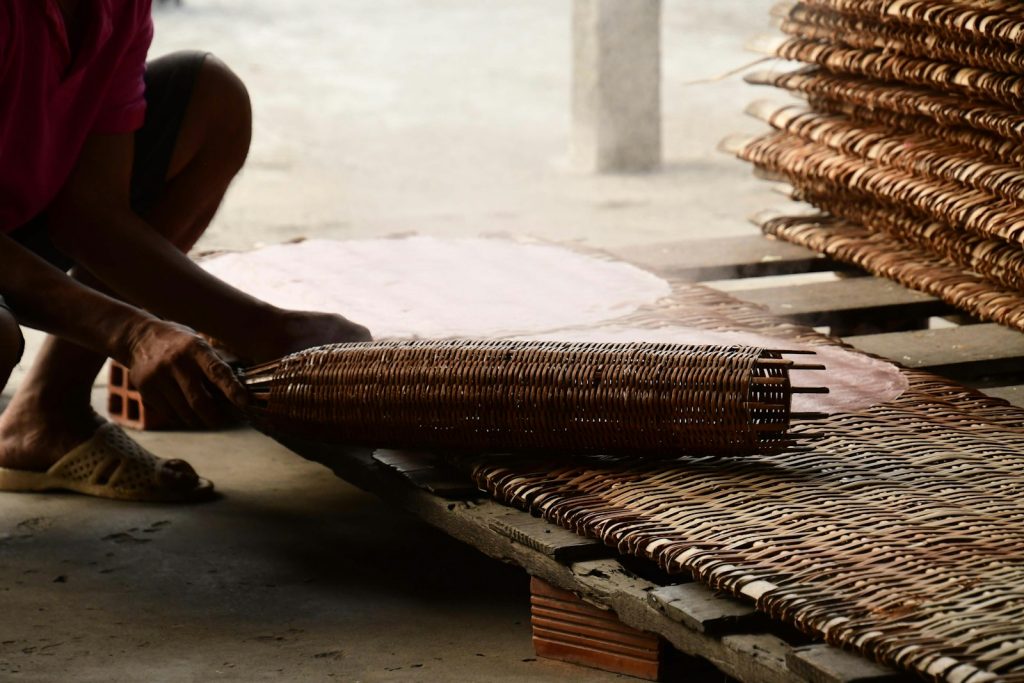
Honest buyer note: Our lamps are handwoven by village artisans in Bali and Java, so expect natural colour variation and a size tolerance of roughly ±1–3 cm on larger shades. All prices, MOQs, lead times and container counts are indicative ranges (2024–2025, FOB Indonesia) and final pricing is by quote. Standard wiring is E27 at 220–240 V; we can supply CE-compliant wiring or shade-only (no electrics) so you meet UL/UKCA or local standards in your market — we don’t imply certification we don’t hold. Natural fibre is moisture-sensitive, so we dry, treat and pack appropriately and recommend acclimatisation on arrival. Rattan is generally not CITES-listed. We coordinate vetted workshops and handle export documentation.
Rattan lamp export Indonesia means shipping handwoven rattan lighting from Indonesian producers to overseas buyers under HS 9405, with agreed FOB terms, packing, and documentation. On this page I walk through how export rattan lighting Indonesia typically works in real trade: HS codes, FOB ranges, MOQ, container loading, fumigation, wiring, and what to check with your customs broker.
At Bali Rattan Lamps, we act as an honest B2B desk to help you import rattan lamps from Bali and Java village workshops with clear expectations—not marketing gloss.
1. Product scope & supply chain overview
What we actually export
Our focus is woven natural-fibre lighting under HS 9405, especially:
– Handwoven rattan pendant lamp shades (single, cluster, and oversized statement pieces)
– Wicker floor and table lamp shades / bases
– Cane, seagrass and bamboo blends (by design)
– OEM / private label shades, plus selected wired fixtures on request
Most buyers use us as an Indonesia rattan lamp supplier for:
– Hospitality fit-outs (villas, hotels, resorts, restaurants)
– Retail chains and concept stores
– Lighting and furniture brands needing consistent OEM production
– Online brands wanting boxed / flat-packed SKUs for e‑commerce
Where and how your lamps are made
Based on current production patterns:
– Design, finishing, QC and export coordination: Bali
– Volume weaving: Java (especially Cirebon area) village workshops under long-term relationships
– Raw rattan: primarily sourced from Kalimantan and Sulawesi via licensed traders
The rattan itself is generally NOT CITES‑listed. Indonesia regulates harvest, processing and export of rattan domestically, and we work with registered processors. Local rules still apply, but you usually do not face CITES paperwork at destination for rattan lamps.
We do not claim “certified sustainable” rattan unless a specific component is backed by valid FSC/PEFC or similar documentation for that batch. Rattan is a fast‑growing renewable fibre and supports artisan livelihoods, but we avoid greenwashing language.
2. HS codes for rattan lamp export Indonesia
For customs classification, most rattan lighting falls under Chapter 94 (Lamps and lighting fittings). Exact classification is always the importer’s responsibility in discussion with your broker, but in practice buyers typically use:
- HS 9405.10
- “Lamps and lighting fittings… of a kind used for ceiling or wall lighting, excluding those of a kind used for lighting public open spaces or thoroughfares.” This is where woven pendant shades/fittings generally sit.
- HS 9405.20
- “Lamps and lighting fittings… of a kind used for table, desk, bedside or floor-standing lamps.” Used for woven floor and table lamps.
- Shade-only vs complete lamp
- Many buyers import shade-only (no electrics) but still classify under 9405.10 / 9405.20. Some local customs may consider shades as parts; coordinate HS decisions with your broker.
Destination countries may apply additional national subheadings (e.g. adding digits after 9405.10), which can affect duty rates. Always confirm the final HS code and any anti‑dumping or additional duties with your customs broker or forwarder before confirming your landed price.
3. Wiring options, voltages and certifications
Shade-only vs wired lamps
We supply in three main configurations:
1. Shade-only (no electrics)
– Most common for EU, UK, US and AU importers.
– You or your local partner add wiring and canopy kits, certified in your jurisdiction.
– Simplifies certification and reduces QC complexity.
2. Shade + basic wiring set (E27, 220–240V)
– Typical contents: E27 lamp holder, PVC cable, ceiling cup, strain relief.
– For markets accepting CE‑compliant wiring and 220–240V, usually EU and some other regions.
– We can source CE‑compliant wiring sets from existing Indonesian suppliers; documentation can be provided for those components.
3. Custom wiring per project (by quote)
– For hospitality projects in 220–240V markets (e.g. Maldives, some EU projects) we can coordinate tailored wiring: cable color, ceiling cup type, cord length.
– For 110–120V markets (US, Canada, parts of Latin America), most buyers still prefer shade‑only and wire with UL-listed kits locally.
Certification and what we do NOT claim
To stay fully honest and trade‑credible:
– Our default in-house standard is E27, 220–240V wiring using CE‑compliant components when wiring is requested.
– We do not claim blanket UL, ETL, UKCA, SAA, or other national certification for complete fixtures.
– Buyers usually either:
– Import shade‑only and pair with locally certified kits, or
– Arrange local testing/approval on a project basis.
For EU importers, we can support CE‑compliant wiring for EU use, but ultimate conformity (including fixture-level testing if needed) is the responsibility of the importer / brand. For UK, US, AU, NZ, and Canada we recommend shade‑only or local wiring.
If certification will be critical for you, mention this clearly in your RFQ so we can structure the offer accordingly.
4. Indicative FOB ranges, MOQs and lead times
All price and capacity metrics below are indicative 2024–2025, FOB Indonesia, last verified June 2026, always by quote. Exact numbers depend on design complexity, weave density, finishing and quantity.
Indicative FOB price ranges (shade-only)
| Item type (shade-only) | Typical size range | Indicative FOB range* (USD) |
|---|---|---|
| Small pendants | Ø20–30 cm | ~US$6–11 |
| Medium pendants | Ø35–45 cm | ~US$9–18 |
| Large pendants | Ø50–60 cm | ~US$14–28 |
| XL pendants | Ø70–100 cm | ~US$26–55 |
| Table lamp shades | H20–35 cm | ~US$6–16 |
| Floor lamp shades | H40–70 cm | ~US$14–30 |
*Ranges assume standard peeled rattan or rattan core, clear lacquer or natural finish, nested packing, FOB Surabaya or Semarang for Java production or FOB Benoa (Bali) if finishing/export is Bali‑based. Wired versions typically add ~US$2–6 per set depending on hardware and cable length.
MOQ (minimum order quantity)
Typical MOQs by line:
– Standard catalogue pendants:
– 30–50 pcs per design / size
– Mixed designs in one shipment usually accepted
– Table and floor lamps:
– 20–30 pcs per design / size
– OEM/custom designs:
– 50–100 pcs per design / size for new molds or complex frames
– Lower MOQs sometimes possible with design simplification or shared frames
MOQ also depends on total export value. As a rough guide, most efficient shipments start around US$5,000–10,000 total FOB value or above, but we do handle smaller test orders with adjusted pricing.
Lead times
Typical lead-time structure:
– Sampling / prototyping:
– Existing shape, new size/finish: about 2–4 weeks
– New custom design: 4–6 weeks including frame development
– Mass production (after deposit and final sample approval):
– Small–medium orders (5–20 cbm total volume): ~6–10 weeks
– Larger orders or multiple SKUs: ~10–14 weeks
– High season (pre‑Christmas, mid‑year for summer ranges):
– Add ~2–4 weeks buffer due to workshop congestion and port traffic.
Lead times exclude ocean transit, customs clearance and inland delivery in your country.
If you are planning a 20′ or 40′ container over multiple SKUs, reach out via plan your trip (we also coordinate via WhatsApp for fast sampling and documentation review).
5. Packing, nesting and container loading
Rattan lighting is volumetric cargo: you pay freight mostly on cubic metres rather than weight. Efficient packing is essential to keep landed cost under control.
Packing methods
We use combinations of:
– Nested packing
– Smaller shades stacked inside larger ones of the same design or family.
– Dramatically improves container utilisation on pendant ranges (especially domes and bells).
– Flat-pack where structurally possible
– Some frames can be designed for partial disassembly (e.g. collapsible support rings) but pure rattan has limits.
– Common on lighter frame + woven outer designs.
– Individual polybag or paper wrapping
– Each shade is wrapped to prevent abrasion.
– Natural, uncoated finishes often receive a breathable paper wrap rather than sealed plastic to reduce trapped moisture.
– Export cartons
– Carton size is optimised to balance protection vs. volume.
– Most buyers use neutral cartons with printed item codes and barcodes; branded packaging is possible at volume.
Indicative container counts
Highly approximate guidance for well‑nested pendant loads:
| Container type | Typical volume (cbm) | Approx. rattan lamp capacity* |
|---|---|---|
| LCL (1–10 cbm) | 1–10 cbm | ~100–800 mixed pendants |
| 20′ FCL | ~28 cbm usable | ~800–1,600 pendants (mix of S–L), fewer if mostly XL |
| 40′ FCL | ~58 cbm usable | ~1,800–3,200 pendants (S–L mix), ~700–1,200 if many XL |
*Counts vary widely with shapes (wide shallow hats vs tall cylinders), nesting efficiency, and share of bulky floor lamps. For project pricing we estimate:
– Volume per SKU (cbm per piece packed)
– Container utilisation based on your planned mix
Share your target container (LCL / 20’/40′) in your RFQ to allow us to optimise designs and sizes for freight efficiency.
Moisture and mould risk management
Rattan and other natural fibres are hygroscopic—they absorb moisture. This is a real risk in tropical production combined with long sea voyages. We manage it with:
– Proper drying
– Sun and kiln drying at the material and finished-goods stage where possible.
– Adequate resting time before packing.
– Breathable or vented packing
– Avoid over‑sealing wet products in plastic.
– Use desiccant packs and container‑level dehumidifier strips where conditions demand.
– Anti‑mould treatment on request
– We can apply clear anti‑fungal sprays or dips used in the furniture export industry.
– Some markets and buyers prefer to limit chemicals; we will follow your instructions and local regulations.
On arrival, we recommend that you:
– Open cartons promptly and allow products to acclimatise in a dry, well‑ventilated space.
– Avoid storing packed rattan directly on cold concrete floors or in damp warehouses.
6. Fumigation, phytosanitary and ISPM 15
Because rattan is a natural plant fibre, some buyers ask about fumigation and phytosanitary controls.
Fumigation and phytosanitary certificates
Standard practice for our export rattan lighting Indonesia shipments:
– Product fumigation
– Many destination customs do not systematically require fumigation for finished rattan products, but some buyers or countries do.
– If required, we can arrange fumigation at an accredited facility and provide a fumigation certificate.
– Methods and chemicals used must comply with Indonesian and destination regulations; we avoid unnecessary treatments.
– Phytosanitary certificate
– Typically more relevant for raw plant materials than finished lamps.
– Some import authorities may still ask for phytosanitary documentation for large orders of natural-fibre goods.
– We can coordinate with quarantine authorities for a phytosanitary certificate when your broker advises it is needed.
Always follow your local customs broker’s advice: regulations differ between US, EU, Australia and other markets and can change.
ISPM 15 for wooden pallets
If shipments use wooden pallets or crates, these must comply with ISPM 15 (heat‑treated and stamped) for most major markets:
– We normally ship in cartons only (no pallets) to maximise volume usage, especially for FCL.
– If you require palletisation, we use ISPM 15 certified pallets and can provide documentation on request.
7. Trade terms: FOB Indonesia, payment and deposits
FOB ports and freight
We usually quote FOB Indonesia:
– FOB Surabaya or Semarang – for Java production
– FOB Benoa (Bali) – for Bali‑finished shipments
FOB terms include:
– Export packing
– Local trucking to port
– Export documentation and customs clearance in Indonesia
– Terminal handling fees on the export side (depending on exact agreement)
You or your forwarder then arrange:
– Ocean freight or air freight
– Marine insurance
– Destination port charges, customs clearance, duties, taxes
– Domestic trucking to your warehouse or project site
We can also arrange CIF/CFR quotations through partner forwarders if you prefer turnkey freight estimates, but we still anchor our costing on FOB for transparency.
Payment terms and deposits
For most new B2B buyers:
– 30–50% deposit on order confirmation
– Balance before shipment or against copy of Bill of Lading (depending on relationship and bank arrangements)
For ongoing trade relationships or established brands, other structures (such as LC) may be discussed case‑by‑case, but assume deposit + pre‑shipment balance as the default.
Samples and small pilot orders are usually 100% prepayment due to high per‑unit handling costs.
8. Import duty context: US, EU and Australia
Duty rates are decided by your customs authority, and you must confirm exact numbers. Below is general, non‑binding context for HS 9405 products—always verify with your broker or customs office.
United States
– Most woven rattan lamps classify around HS 9405.10 or 9405.20.
– Base MFN duty rates for such lighting fixtures have historically been in the single‑digit % range, but you must check the current US HTS and any special tariffs or exclusions.
– There is no special anti‑dumping measure on Indonesian rattan lamps currently known in the US, but classification/valuation audits are possible.
For US buyers:
– Confirm with your broker how CBP will treat shade‑only vs complete fixture.
– Check if any additional environmental or electrical safety rules apply at the state level.
European Union
– Imports under HS 9405 into the EU typically face low to moderate ad valorem duties, plus import VAT at your local rate.
– Exact duty rate can depend on the combined nomenclature code (extra digits after 9405.10 / 9405.20).
Key points:
– Electrical safety and CE compliance matter more when importing wired fixtures. Shade‑only imports face less technical scrutiny.
– Some EU states may ask about REACH compliance for coatings/lacquers. We can obtain SDS/technical sheets for varnishes and finishes used by our partner workshops when needed.
Australia
– Under HS 9405, imports from Indonesia may benefit from trade preferences where applicable.
– Most rattan furniture and décor from Indonesia into Australia has historically faced relatively low duty rates, but quarantine/biosecurity controls are more stringent.
Australian buyers should:
– Check with their broker about any specific biosecurity requirements for rattan and natural-fibre products: fumigation, treatment records, or inspection.
– Be prepared for possible AQIS inspection fees and storage if a container is held for checks.
Again, these are broad patterns, not legal advice. Duty rates and import rules can change. Always confirm:
– HS code
– Duty rate
– Any additional taxes or anti‑dumping
– Biosecurity requirements
with your licensed broker before finalising your landed costing.
9. Quality, handmade variance and tolerances
Handmade character and tolerances
Every rattan lamp is woven by hand. We aim for consistent quality suitable for international retail, but natural and handmade variance is real.
Typical tolerances:
– Dimensions: approximately ±1–3 cm on large shades (especially Ø50 cm and above).
– Color: variation in tone between batches and within a single piece due to natural cane variation and manual staining.
– Weave: minor irregularities where strands join or change direction.
We manage quality by:
– Pre‑production sample approval (with your comments on color, tightness, finish).
– Agreed QC checklist (size tolerances, shape fidelity, structural strength, weaving density).
– Batch inspections before packing; photo or video QC reporting for remote buyers.
If you need tighter tolerances (e.g. for multi‑shade cluster installations where exact alignment is crucial), we can:
– Use heavier frames and stricter weaving specs; and
– Adjust pricing to reflect extra time and rejection rates.
Finishes and coatings
Common options:
– Raw/natural rattan with clear topcoat (matte or semi‑gloss)
– Light wash / whitewash
– Dark stains (walnut, espresso, custom tones by sample)
Each finish affects:
– Color consistency and visible variance
– Moisture resistance and cleanability
– Cost and lead-time (darker or special stains often require more process steps)
Share your finish expectations with reference photos (or physical swatches) in your RFQ so we can quote accurately.
10. Working with Bali Rattan Lamps: OEM, samples, RFQ
OEM and custom development
As an Indonesia rattan lamp supplier focused on B2B, we often:
– Adapt your sketches/CAD into feasible rattan frames and weaves.
– Resize existing catalogue shapes to match your range.
– Translate brand moodboards into coordinated families (pendant + table + floor).
Design constraints we consider:
– Maximum diameter and height vs. container efficiency.
– Wire exit points and hardware compatibility for local wiring.
– Structural stability; avoiding shapes that will deform in transit.
Custom development typically involves:
1. NDA or basic confidentiality understanding (if needed).
2. Feasibility review, rough FOB range and MOQ indication.
3. Prototype quote and sampling deposit.
4. Prototype production and photo/video review; physical sample courier if required.
5. Costing confirmation and PO for mass production.
Samples and shade sets
Sampling options:
– Single‑design sample: shade‑only or wired, shipped by air courier.
– Assortment box: multiple catalogue items with mixed sizes/finishes to review quality and market reaction.
Sampling costs are typically higher per unit than bulk, plus freight. For serious volume RFQs, we may credit part of sampling cost against your first production order—subject to agreement.
Request for quotation (RFQ)
To receive a meaningful quote, please share:
– Destination country and preferred port (for freight context).
– Target import mode: LCL, 20’ or 40’ FCL.
– Product list with approximate quantities per SKU (or at least per size category).
– Whether you want shade‑only or with wiring, and your target voltage/market (EU/UK/US/AU).
– Required or expected HS code proposed by your broker (if known).
– Expected delivery window (e.g. “ready to ship from Indonesia by October”).
Use our contact page to start the process and attach files:
plan your trip — and if you prefer fast back‑and‑forth, mention that you would like to continue detailed RFQ discussions via WhatsApp.
11. Key documents for rattan lamp export Indonesia
Standard export documentation package typically includes:
– Commercial Invoice
– Seller and buyer details; HS code; Incoterms; item description; unit and total values; currency.
– Packing List
– Carton count, dimensions, weights, item breakdown per carton.
– Bill of Lading (B/L) or Air Waybill (AWB)
– Issued by the carrier or forwarder; used for shipment release and payment milestones.
– Certificate of Origin (COO)
– For some markets, a COO or preferential origin document (e.g. under regional trade agreements) can reduce duty.
– We can arrange standard Indonesian COO forms where applicable.
– Fumigation Certificate / Phytosanitary Certificate (if applicable)
– Provided when fumigation or plant health inspections are conducted at your broker’s request.
– Insurance Certificate (only if freight and insurance are arranged through us)
– Under FOB you usually handle insurance; under CIF/CFR we may help source it.
Buyers sometimes also request:
– Product specification sheets for wiring components (if supplied).
– Test reports or MSDS for coatings, glues, or treatments (especially for EU buyers).
Let us know early if your retailer or project client has additional compliance documentation requirements.
12. How to proceed
If rattan lamp export Indonesia is part of your sourcing plan for the next season or project:
1. Clarify your target market and channels (retail, hospitality, e‑commerce).
2. Align with your customs broker on HS codes and duty expectations.
3. Decide shade‑only vs wired approach and local certification strategy.
4. Prepare an initial RFQ with volumes and styles, even if approximate.
5. Contact us for an indicative 2024–2025 quote range, production slot check and sampling plan.
You can start here: plan your trip. We respond with clear next steps via email, and are happy to move to WhatsApp once we’re aligning designs, photos, and packing details.
—
What HS code do rattan lamps use?
Most woven rattan lamp shades and fixtures are classified under HS 9405.10 (ceiling or wall lighting) or HS 9405.20 (table, desk, bedside or floor-standing lamps). Exact 6–10 digit classification depends on your national tariff schedule, product configuration and your customs broker’s advice.
Do rattan lamps need fumigation or a phytosanitary certificate?
Many countries do not require fumigation for finished rattan lamps, but some brokers or authorities prefer it, especially for large volumes. We can arrange fumigation and issue a certificate if requested, and coordinate a phytosanitary certificate when your broker advises it is necessary. Always confirm with your broker for your specific country and HS code.
What duties will I pay to import rattan lamps from Bali?
Import duty depends on your country, the exact HS code, and any applicable trade agreements. Rattan lamps under HS 9405 typically face low to moderate ad valorem duty rates in the US, EU and Australia, plus VAT/GST where applicable, but you must check the latest tariff with your customs broker. We can support with product data; we cannot set your duty rate.
How are rattan lamps packed for export?
We typically use nested packing, where smaller shades stack inside larger ones, each wrapped in paper or polybag and then loaded into export cartons. Cartons are sized to balance protection and volume efficiency. For some models we can partially flat-pack. ISPM 15-certified pallets are available if you require palletisation; otherwise we usually ship cartons only.
What documents will I receive with my shipment?
A standard export package includes Commercial Invoice, Packing List, Bill of Lading or Air Waybill, and Certificate of Origin. When arranged, we also provide Fumigation and/or Phytosanitary Certificates. For wired products we can share component specifications and finish MSDS on request. Your customs broker can advise if any additional documents are needed for your market.