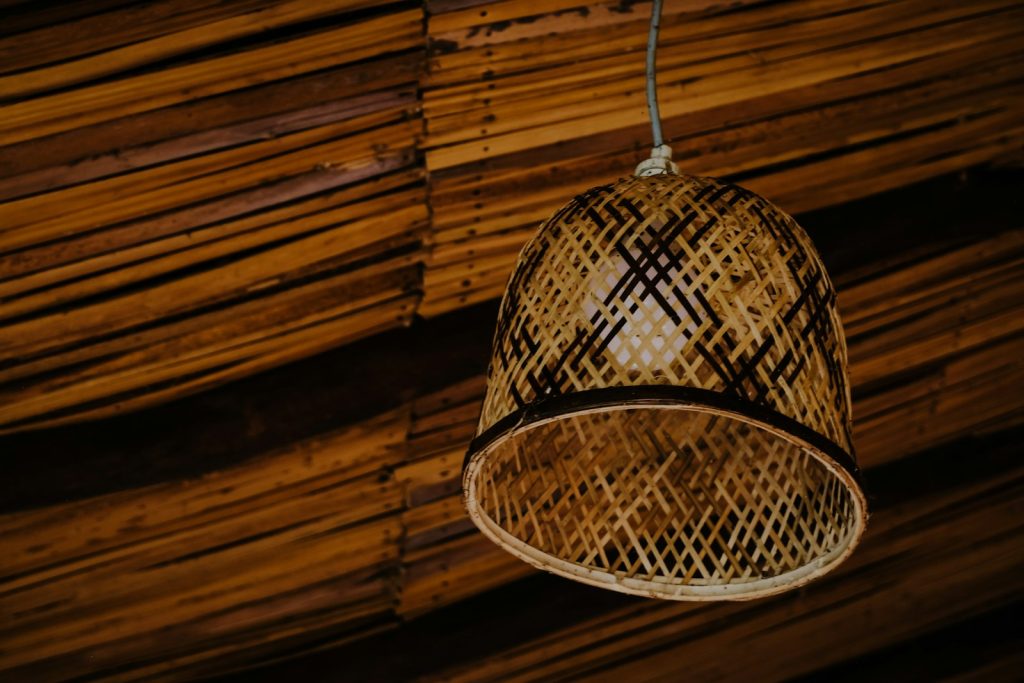
Honest buyer note: Our lamps are handwoven by village artisans in Bali and Java, so expect natural colour variation and a size tolerance of roughly ±1–3 cm on larger shades. All prices, MOQs, lead times and container counts are indicative ranges (2024–2025, FOB Indonesia) and final pricing is by quote. Standard wiring is E27 at 220–240 V; we can supply CE-compliant wiring or shade-only (no electrics) so you meet UL/UKCA or local standards in your market — we don’t imply certification we don’t hold. Natural fibre is moisture-sensitive, so we dry, treat and pack appropriately and recommend acclimatisation on arrival. Rattan is generally not CITES-listed. We coordinate vetted workshops and handle export documentation.
Bamboo pendant lights wholesale means bulk supply of handwoven bamboo ceiling lamps for retailers, projects and brands, usually FOB Indonesia with export packing and documentation included. At Bali Rattan Lamps, we coordinate design, weaving, finishing and export of bamboo pendant lights wholesale from Bali and Java workshops, with honest pricing ranges, clear MOQs and realistic lead-times.
What You Actually Get: Wholesale Bamboo Pendant Lights from Bali & Java
Bali Rattan Lamps is the trade-facing desk linking overseas buyers with vetted bamboo lighting workshops in Bali and Java (primarily Cirebon). We are not a factory front; we organize:
– Design development and samples in Bali
– Volume weaving and frames in Java (Cirebon area) and parts of East Java
– Finishing, QC consolidation and export out of Bali or Java ports (FOB Indonesia)
Typical bamboo pendant assortments we ship include:
- Open frame bamboo pendants (hoops, ribs, cages)
- Bamboo + rattan weave shades (bamboo frame with rattan skin or accents)
- Pillar and drum-shaped bamboo pendants (vertical or horizontal slats)
- Lattice (crossed-strip) domes and cones
- Natural, caramelised (smoked/torched) and painted finishes
We work B2B only: importers, lighting brands, retailers, interior contractors and hospitality projects. Retail and one-off orders are not our focus.
Bamboo Construction: Frames, Weaves and Light Effect
Most of the “wholesale bamboo lamp” styles we ship are built on simple, repeatable constructions that behave predictably in loading and in use.
Bamboo Frames: Hoops, Ribs and Pillars
In Java and Bali, bamboo pendant frames are usually made from:
- Split bamboo hoops – thin splits bent into circles and tied/nailed to form top and bottom rings.
- Vertical ribs – thicker splits or small poles running from top ring to bottom ring, fixed with rattan binding or staples.
- Pillar slats – evenly spaced vertical strips creating a “bamboo pillar” look, common in restaurant and villa projects.
For our bamboo pillar pendants:
– Diameter: commonly 25–45 cm
– Height: 30–80 cm
– Slat spacing: usually 0.8–2.5 cm, depending on desired light spill
– Thickness: 2–4 mm strips for pendants; heavier for floor lamps
Frames are usually bound with rattan peel (rotan kulit) or synthetic cord at stress points. The binding is visible but tidy; we do not hide it because it is part of how these pieces actually hold together.
Bamboo Weaves: Open, Lattice and Combination Skins
Beyond bare frames, we specify three broad weave strategies:
- Open slat / cage – simple vertical or angled strips; strong shadows, maximum airflow, lowest material cost.
- Lattice cross-weave – strips woven over/under into diamonds or squares; medium light diffusion, more labor per shade.
- Bamboo + rattan skins – bamboo frame with rattan peel, core, or seagrass woven over it; softer light and more “rattan look” but with a stiff bamboo skeleton.
Because these are handmade, we state dimensional tolerance of approximately ±1–3 cm on large shades. For tight installation grids or multi-cluster chandeliers, we recommend ordering a pre-shipment measurement sheet and allowing a bit of adjustment space in your ceiling layout.
Bamboo vs Rattan: Look, Performance and Cost
Below is a practical comparison for buyers deciding between a bamboo rattan pendant bulk order and pure rattan.
| Aspect | Bamboo Pendant (Frame/Weave) | Rattan Pendant (Woven Core/Peel) |
|---|---|---|
| Visual character | More linear, architectural; visible nodes and slats | Softer, more organic; rounded strands and tighter curves |
| Light effect | Sharper stripes and geometric shadows | Softer diffusion, especially with tight weave |
| Material behavior | Hollow grass; can crack if too dry or forced | Solid vine; slightly more forgiving to bend |
| Average labor time per shade | Lower for simple slat/cage designs; higher for lattice domes | Higher for full tight-weave surfaces |
| FOB price tendency* | Often slightly lower at equivalent size | Moderate to higher due to labor and material |
| CITES / export regulations | Not CITES-listed | Most commercial rattan varieties not CITES-listed; local harvest rules still apply |
| Use cases | Modern, Japandi, beach bar, cafés, villas | Boho, coastal, rustic, resort, residential |
*FOB Indonesia, indicative 2024–2025 ranges only; specific quotes vary by spec and volume.
For many B2B buyers, the most efficient move is to mix bamboo and rattan across a range: bamboo pillars and cages for volume restaurant tables, tighter rattan domes or seagrass shades for feature areas.
Durability and Where Bamboo Lamps Actually Make Sense
Bamboo pendants perform well in the environments they’re designed for, but there are limits.
Indoor and Roofed Use
We recommend bamboo pendant lights primarily for:
- Indoor residential (living, dining, bedrooms)
- Commercial interiors (restaurants, cafés, shops, hotel lobbies)
- Covered terraces and verandas where they are not directly exposed to rain
With proper drying, finishing and indoor use, lifespan is measured in years. Expect some color mellowing from fresh light-yellow to a warmer tone over time.
Moisture, Mould and Climate Risk
Natural bamboo and rattan absorb moisture. The risks:
- Mould spotting if shipping or storage is damp and airless.
- Warping if pieces leave a humid factory and move into very dry, heated spaces too fast.
To manage this, we work with exporters who:
- Sun- and kiln-dry material as needed before weaving.
- Hold finished shades in ventilated storage before packing.
- Use anti-mould sachets and vent-holes in cartons where appropriate.
We still advise importers to:
- Unpack containers promptly on arrival and allow shades to acclimatise before plastic wrapping for retail.
- Avoid long-term storage in sealed, humid basements or containers.
We do not claim bamboo pendants as “outdoor weatherproof.” For exposed exteriors, expect accelerated aging and consult us for more robust constructions or alternative materials.
Size Ranges, Shapes and Popular Bamboo Pendant Types
Standard Size Bands (Indicative)
Most wholesale bamboo lampshade export orders cluster into these size bands:
- Small pendants
- Ø18–28 cm, height 20–30 cm; typically used in clusters or rows over bars.
- Medium pendants
- Ø30–45 cm, height 25–45 cm; main restaurant tables and residential dining.
- Large feature pendants
- Ø50–70 cm, height 35–60 cm; hotel lobbies, double-height spaces, statement pieces.
- Extra-large project specials
- Ø80–120 cm+; generally custom-engineered and packed 1–2 pcs per carton.
Dimensional tolerance remains roughly ±1–3 cm for large shades. If you need strict sizing for track systems or rigid metal frames, flag that in your RFQ.
Core Bamboo Pendant Families We Ship Frequently
- Pillar bamboo pendants – vertical slat cylinders, sometimes with inner diffuser cages; efficient on space in containers.
- Bamboo cage cones and bells – lighter builds, strong linear shadows; good for cafés and retail rollouts.
- Lattice bamboo domes – cross-woven strips over round frames; more labor, more decorative.
- Bamboo + rattan collar pendants – bamboo frame with a rattan or seagrass band; used by brands that want variation with shared components.
- Cluster-capable mini pendants – smaller diameters, standardized top openings for multi-drop canopies.
FOB Price Ranges & MOQs for Bamboo Pendant Lights (Indicative)
All price guidance here is:
– Indicative 2024–2025
– FOB Indonesia (Bali or Java port, depending on consolidation)
– By quote only – your actual price depends on spec, finishes, metalwork, packing and total volume
Indicative FOB Ranges (Last Verified June 2026)
For baseline context only:
- Small open-frame bamboo pendants (Ø18–28 cm, simple cage):
Approx. USD 4–9 FOB per piece at volume. - Medium bamboo pendants (Ø30–45 cm, open or simple lattice):
Approx. USD 7–15 FOB per piece at volume. - Large bamboo pillars / domes (Ø50–70 cm, more complex lattice or combo materials):
Approx. USD 14–35 FOB per piece at volume. - Bamboo + rattan weave combo pendants, painted or smoked finishes:
Typically 10–25% higher than the plain bamboo equivalents.
Again, these are framing numbers only. Send specs and target quantities via plan your trip (we use WhatsApp a lot during sampling and packing planning) and we will confirm what is realistic with current labor and material conditions.
MOQ: Per Design and Per Shipment
MOQs vary by workshop and complexity, but for bamboo rattan pendant bulk orders we typically work with:
- Per SKU MOQ:
- Simple bamboo cage / pillar pendants – around 50–100 pcs per size/color.
- More complex lattice or combo-material shades – often 50 pcs+ per SKU.
- Per shipment MOQ:
- Consolidated LCL – possible for small brands/test orders, but unit cost is higher.
- 20ft container – typically loaded with 400–900 pendants depending on size mix and carton plan.
- 40ft HQ container – often 900–1,800+ pendants on mixed-size programs.
Mixed containers with rattan, seagrass and bamboo lampshades are common. Provide your target assortment, and we can suggest how to make the CBM and volume work efficiently.
Export Logistics, Packing and Lead-Times
Packing for Bamboo Lampshade Export
Exporters we work with pack bamboo pendant lights wholesale using:
- Individual polybags or tissue-wrapped shades for abrasion protection.
- Strong cardboard cartons with internal supports or nesting (small inside large) to use space efficiently.
- Desiccant / anti-mould sachets and ventilation holes as appropriate for your climate and transit time.
- Clear outer labeling with SKU, dimensions and piece counts.
If you need retailer-ready packaging (printed boxes, swing tags), this moves the discussion into OEM and will affect FOB pricing and MOQs.
Lead-Times (Production + Export)
Lead-times depend on season, complexity and volume. As indicative guidance:
- Sampling / development: 3–6 weeks depending on feedback cycles.
- Standard repeat orders, one container: usually around 8–12 weeks from deposit to FOB.
- Peak season or multi-container programs: allow 10–16 weeks from deposit to FOB.
Transit time to your port then depends on your freight choices and routes; we coordinate up to FOB and you or your forwarder handle sea freight and local import clearance.
OEM and Custom Bamboo Pendant Development
A significant share of our wholesale bamboo lamp business is OEM: custom designs developed for a single brand or project.
How Custom Development Works
A typical OEM process:
- Design brief & reference – you share sketches, reference photos or CAD with target sizes and price band.
- Material + weave proposal – we suggest bamboo thickness, frame structure, and whether to include rattan, seagrass or fabric diffusers.
- Prototyping – 1–3 rounds of samples shipped to you or checked via detailed photo/video if time is tight.
- Engineering for packing – confirming how shades nest or collapse; adjusting dimensions if necessary for container yield.
- Production – locking spec sheets and QC standards, then scheduling weaving and finishing.
Realistically, a fresh custom range from first sketch to loaded container can take several months, especially if you require in-person sample checks. Plan your design calendar accordingly.
What Is and Isn’t Possible in Bamboo
Bamboo is highly flexible at thin gauges but not endlessly so. We can usually support:
- Cones, domes, drums, ovals and organic bell shapes.
- Angular geometries (prisms, hexagons) with framed corners.
- Special finishes: torched/smoked, light stain, paint in RAL/NCS approximations.
We are more cautious with:
- Very tight radii in thick bamboo – higher risk of cracking.
- Super-flat, tensioned panels without a supporting frame.
- Compressed shipping concepts (fold-flat lattices) that rely on end-user shaping unless you’re prepared for higher return risks.
Discuss your concept via plan your trip. Sharing photos and quick WhatsApp videos back and forth makes it much easier to align expectations before you commit to tooling or large MOQs.
Wiring, Certification and What We Actually Supply
We are strict about how we describe electrics and compliance.
Standard Wiring Options
For most markets:
- Shade-only – the safest and most common; you buy the bamboo lampshade export from us and install your own local wiring kits.
- Basic E27 pendant sets – 220–240V, typically black or white cable and ceiling cup; intended for markets where installers are comfortable with generic CE-compliant component sets.
Key points:
- Standard fitting: E27 bulb holder unless you request something else.
- Voltage: designed for 220–240V systems as commonly used in Indonesia and much of the world.
- Bulbs: not included unless agreed; we recommend LED to manage heat and energy use.
Certification Responsibilities
We can support CE-compliant wiring for EU-bound projects at the component level, but we do not claim blanket CE, UL or UKCA certification for every finished lamp unless a specific, documented program has been executed with you.
For avoidance of doubt:
- CE – we can source and assemble components that are CE-compliant for EU, but final conformity responsibility usually sits with the importer/brand.
- UL / UKCA – buyers typically re-wire or test locally; we do not state universal UL or UKCA certification.
- Shade-only models – treated as non-electrical decorative goods; you wire them with locally certified kits.
If you operate in highly regulated markets, we generally advise importing shade-only and pairing with your in-market certified electrics.
Material Sourcing and Sustainability Claims
Bamboo and rattan are both fast-growing natural materials and contribute to village livelihoods; those are real positives. At the same time, we avoid overstated eco claims.
- Bamboo – locally grown in Bali and Java; fast-renewing grass, widely available.
- Rattan – for combo designs, typically supplied from Kalimantan and Sulawesi via established traders.
- CITES – the commercial rattan species used are generally not CITES-listed, but Indonesian harvest and export regulations still apply and are followed by our partners.
We only use terms like “certified sustainable” where documentation exists (e.g. FSC/PEFC for certain wood components). If you require certification-backed materials, raise this at RFQ stage; it will narrow the pool of workshops and influence price and lead-time.
Quality Control and Handmade Variance
Every shade is hand-framed and woven in village workshops; no two pieces are absolutely identical. We manage this rather than pretending it doesn’t exist.
Tolerances and Visual Variation
Buyers should anticipate:
- Size variance – around ±1–3 cm on larger pendants.
- Color nuance – natural fibers vary from batch to batch; caramel/smoked finishes can display tone shifts between lots.
- Weave irregularities – slight line wobbles or knot positions that mark human work rather than stamped output.
We work with exporters who maintain:
- Incoming material checks and sorting by color and diameter.
- In-line supervision in workshops for frame consistency.
- Pre-packing inspections to weed out cracked, heavily stained or structurally weak pieces.
Photography and pre-shipment video calls are common parts of our process so you can see what a production batch actually looks like before it sails.
How to Start: RFQ for Bamboo Pendant Lights Wholesale
To move from interest to a usable quote, please share:
- Approximate designs or style references (photos, links or sketches).
- Target sizes (diameter and height) and finish (natural, smoked, stained, painted).
- Preferred construction: pure bamboo frame, bamboo + rattan, lattice vs open slat.
- Indicative quantities per SKU and per first shipment.
- Destination country/port and if you prefer shade-only or wired.
- Any special certifications or packaging needs.
Send this via our plan your trip page; we usually continue working detail via email and WhatsApp so we can swap drawings and sample photos quickly.
What’s a Realistic First Order?
For a brand testing bamboo pendant lights wholesale from Indonesia, we often see:
- 3–6 SKUs in coordinated sizes/finishes.
- 50–150 pcs per SKU.
- One mixed container shared with other rattan/seagrass lines, or a well-packed LCL if unavoidable.
After sell-through is understood, follow-up orders usually tighten SKU selection and grow per-SKU volumes, which improves FOB pricing and container efficiency.
FAQ: Bamboo Pendant Lights Wholesale from Bali & Java
Bamboo vs rattan: which is better for pendant lights?
Neither is universally better; bamboo is more linear and architectural, often slightly cheaper for simple frames, while rattan gives a softer, more organic texture and typically more diffused light. Many buyers mix both: bamboo for cages and pillars, rattan for tighter woven domes and accents.
What FOB price range should I expect for wholesale bamboo lamp orders?
Indicative 2024–2025 FOB Indonesia ranges (last verified June 2026) are roughly USD 4–9 for small simple cages, USD 7–15 for medium sizes, and USD 14–35 for larger or more complex bamboo pendants at volume. Exact prices depend on size, design complexity, finishes, packing and total order quantity and are confirmed only by quote.
How durable are bamboo pendant lights in real use?
Indoors and under cover, well-dried and finished bamboo pendants last for years, with some natural color mellowing. They are not designed for constant direct rain or harsh outdoor exposure. Good handling of humidity during shipping and storage is important to avoid mould and warping.
What is the MOQ for bamboo rattan pendant bulk orders?
For simple bamboo pendants the per-SKU MOQ is usually around 50–100 pcs per size/color, with a practical shipment MOQ of one well-filled LCL or, more efficiently, a 20ft or 40ft container mixed across SKUs. More complex designs may have higher MOQs; we confirm specifics during quoting.
Can you make custom bamboo lampshades and supply them under our brand?
Yes. We do OEM development frequently, from adapting existing workshop patterns to fully custom shapes with your finishes and packaging. You share designs, specs and volumes; we prototype, refine construction for weaving and packing, then produce under your label. Reach out via plan your trip and we’ll start the process, using WhatsApp where helpful to streamline reviews.