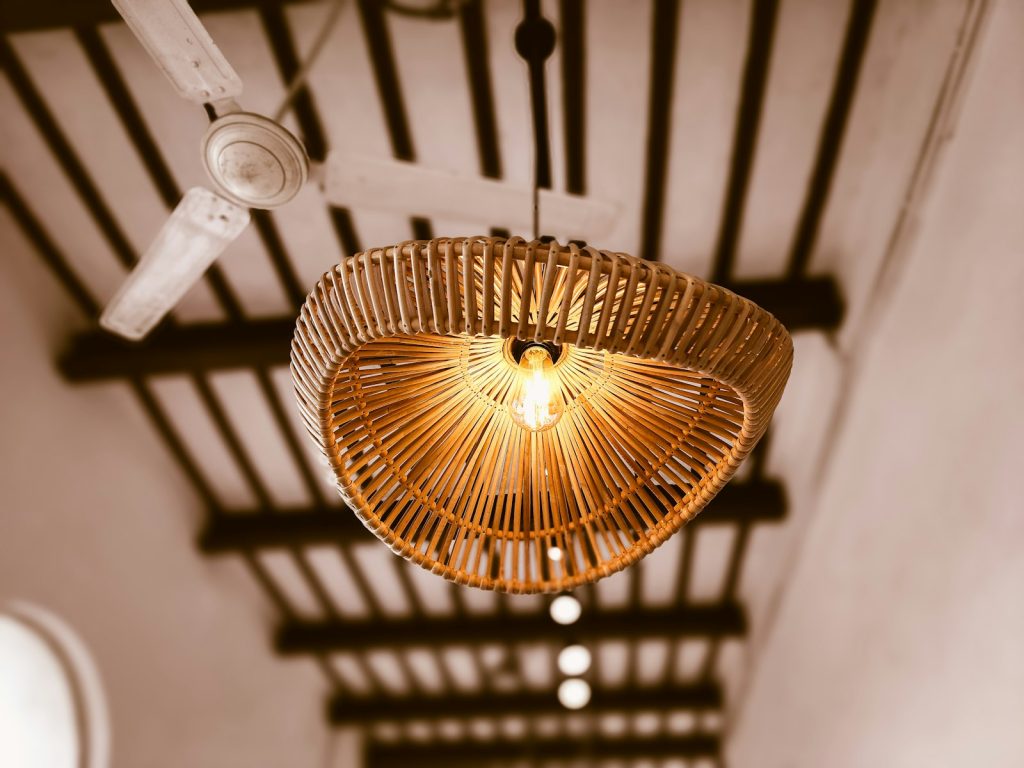
Honest buyer note: Our lamps are handwoven by village artisans in Bali and Java, so expect natural colour variation and a size tolerance of roughly ±1–3 cm on larger shades. All prices, MOQs, lead times and container counts are indicative ranges (2024–2025, FOB Indonesia) and final pricing is by quote. Standard wiring is E27 at 220–240 V; we can supply CE-compliant wiring or shade-only (no electrics) so you meet UL/UKCA or local standards in your market — we don’t imply certification we don’t hold. Natural fibre is moisture-sensitive, so we dry, treat and pack appropriately and recommend acclimatisation on arrival. Rattan is generally not CITES-listed. We coordinate vetted workshops and handle export documentation.
Natural fiber lighting wholesale means sourcing handwoven rattan, bamboo, seagrass and related lamp shades and fixtures in volume directly from producers. At Bali Rattan Lamps, we coordinate OEM and custom production across Bali and Java for importers, brands and projects that need reliable woven natural lighting in bulk.
We are a handwoven lamp supplier focused on B2B: pendant shades, floor and table lamp shades, wall lamps and chandeliers in rattan, bamboo, seagrass, water hyacinth, abaca and synthetic “rattan” for outdoor. Design support, sampling, production and export logistics are handled from Bali; volume weaving is done in village workshops in Java (mainly Cirebon) plus small-batch work in Bali.
Indicative 2024–2025 ranges (FOB Indonesia, by quote, last verified June 2026):
– Typical FOB ex-port (Semarang / Surabaya / Bali) for handwoven natural-fiber lamp shades: USD 7–35 per piece depending on size, weave density and finish.
– Standard MOQs: 50–100 pcs per style/size, 200–300 pcs total mix for consolidated shipments.
– Usual production lead time: 6–10 weeks after deposit and sample sign-off, plus shipping time.
All figures are ranges only; every RFQ is quoted to your exact spec, volume and packing plan.
—
Natural Fiber Lighting: Materials We Work With
Natural fiber lighting in our context means lamp shades and woven components made from plant-based or plant-mimicking fibers. Each behaves differently in production and in your end market. Below is how we actually use them in Bali and Java workshops.
1. Rattan (Cane, Peel, Core)
Rattan is our primary material for woven natural lighting bulk.
– Origin & sourcing
Raw rattan canes are largely harvested in Kalimantan and Sulawesi and sent to Java for splitting, peeling and pre-processing. For export lighting we generally work with:
– Rattan peel/“sega” (flat or semi-round strips) for open and lattice weaves.
– Rattan core (round, smaller-diameter) for frames and ribbing.
– Look
– Natural warm beige to light honey.
– Can be left raw, lightly clear-coated, smoked, limed, or stained in browns/black.
– Takes an open, airy weave very well, good for large pendant domes and drums.
– Durability & use
– Excellent strength-to-weight ratio; keeps form on larger pendant shades.
– Best for indoor and covered outdoor (e.g. roofed terraces, verandas) – not for direct, persistent rain.
– With correct drying and finish, rattan stays stable for years in normal indoor humidity.
Important regulatory point: the common commercial rattan species we use for lighting are generally not CITES-listed, so they are typically exportable under local Indonesian forestry and trade regulations, not under CITES quotas. We still respect domestic harvest and transport rules for our suppliers.
2. Bamboo (Slats, Strips, Poles)
Bamboo is widely used in Java weaving centers for both structure and surface.
– Look
– Visibly segmented grain (nodes) on poles; smoother on split slats.
– Works well for geometric frames, cage pendants and lantern-style shades.
– Often combined with rattan binding on the joints.
– Durability & use
– Harder outer skin gives good rigidity.
– Slightly more prone to cracking if over-dried or used in very low humidity environments.
– Indoor or covered outdoor recommended; fully exposed outdoor use will shorten lifespan.
3. Seagrass
Seagrass refers to dried, twisted coastal grasses used as cord.
– Look
– Distinct textured rope appearance; color from pale straw to olive-green-brown.
– Gives lamps a more rustic, coastal aesthetic, often in tight spiral wraps or braided weaves.
– Durability & use
– Strong but more absorbent than rattan.
– Better for indoor, lower-humidity spaces, or at least well-ventilated rooms.
– Not ideal for bathrooms, damp basements or unventilated coastal houses unless well managed.
4. Water Hyacinth
Water hyacinth is an invasive aquatic plant dried and twisted into cord or plait.
– Look
– Thick, chunky braids and coils; visible “leafy” texture.
– Tends toward earthy light-brown tones; sometimes combined with rattan frames.
– Durability & use
– Comfortable hand-feel and strong, but absorbs moisture easily.
– Best reserved for dry indoor spaces.
– Needs good drying before packing to mitigate mold risk.
5. Abaca (Manila Hemp)
Used more for wrapped shades and soft lamp details than pure structural weave.
– Look
– Fine, fibrous texture; can be yarn, cord or paper-like sheets.
– Works nicely as diffusers inside a rattan frame or for softer “cloud” pendants.
– Durability & use
– Not as structurally strong as rattan or bamboo.
– Appropriate for decorative, non-structural surfaces in dry indoor areas.
6. Synthetic “Rattan” (Poly-Rattan) for Outdoor
For true outdoor specifications, we work with PE or HDPE synthetic weave designed for UV and water resistance.
– Look
– Extruded “wicker” strips mimic natural rattan or seagrass; available in many colors and profiles.
– Typically woven over aluminum or powder-coated steel frames for outdoor pendants and wall fixtures.
– Durability & use
– Designed for fully outdoor use: patios, pool areas, beach clubs.
– More color-stable in harsh sun and much less prone to mold than plant fibers.
We always label synthetic clearly; it is not a natural fiber, but is often essential for hospitality projects requiring outdoor performance.
—
Weaves, Shapes and Construction: How Your Lamps Are Actually Made
Every fiber responds differently in the hands of a weaver. For buyers, understanding weave style and structure helps explain both pricing and long-term performance.
Open vs Lattice vs Tight Weave
– Open weave
– Widely spaced rattan or bamboo strips (for example 2–3 cm gaps).
– Produces strong shadow patterns and allows maximum light through.
– Uses less material and labor → more cost-efficient per volume and lighter to ship.
– Lattice weave (cross / cane-web style)
– Geometric crossings: hexagonals, diamonds, squares.
– Often used on drum, dome or bell-shaped pendants.
– Balance between light diffusion and texture; medium material and labor load.
– Tight weave (close wicker or plait)
– Fibers packed with minimal gaps, seagrass or water-hyacinth braids, or fine rattan cane.
– Gives more diffused light, often a softer glow with fewer shadows.
– Requires more weaving hours → higher FOB range, especially for larger diameters.
Frame Types
Most shades use one of three structures:
– Full rattan frame
– Bent rattan poles form the ribs; lighter and fully “natural”.
– Best for mid-size pendants and light floor/table shades.
– Metal frame (wire, mild steel)
– Thin wire/rod structure powder-coated or painted to resist corrosion.
– Used for very large shades, precise geometric forms, or synthetic outdoor weaves.
– Cost slightly higher due to metalwork, but consistency is improved.
– No rigid frame (self-supporting basket weave)
– Very tight, structural weaves that hold their form.
– Often used for smaller table lamp shades or baskets; less common for wide pendants.
Common Lamp Shapes in Natural Fiber
– Bell, dome and cone pendants
– Drums and cylinders
– Tiered and chandelier-style multi-level forms
– Organic “cloud”, “onion”, “pear” or asymmetric shapes
– Classic tapered table and floor shades
As a handwoven lamp supplier, we can adapt most of these forms from existing references or your CAD drawings, then prototype in Bali before moving volume weaving to Java workshops.
—
Indoor vs Outdoor: Choosing Between Natural and Synthetic
A major decision in natural fiber lighting wholesale is where the lamps will be used and how much exposure to weather and humidity they will face.
Indoor and Covered Outdoor Use
For indoor or covered outdoor (roofed, no direct rain) areas, we generally recommend:
– Rattan (peel and core)
– Bamboo (with good finish)
– Seagrass and water hyacinth in well-ventilated, non-damp rooms
– Abaca elements used decoratively
These can be used in:
– Living rooms and bedrooms
– Restaurants and cafés
– Hotels and spas
– Verandas, pergolas and covered terraces
We still advise importers to inform their retail or hospitality clients:
– Avoid installing plant-fiber lamps directly above steam sources or within unventilated bathrooms.
– Avoid very low, enclosed ceilings in very humid climates without airflow.
True Outdoor Installations
For fully outdoor locations (open decks, poolside, coastal bars with direct exposure), we usually specify:
– Synthetic rattan weave (PE/HDPE)
– On aluminum or powder-coated steel frames
– With outdoor-rated wiring and fittings installed in the destination market
Natural fibers can be used in such locations only if:
– They remain well sheltered from rain and prolonged sun, and
– The project accepts a shortened lifespan and changes in appearance (graying, micro-cracks).
For serious outdoor projects, we usually provide shade-only and recommend local electricians provide outdoor-graded electrics compliant with local code.
—
Moisture, Mold and Color Variation: Honest Risks and How We Manage Them
Natural fiber lamps are exactly that: natural. They react to climate, storage and time. We prefer to be explicit.
Drying and Anti-Mold Protocols in Production
Our Bali and Java partners:
– Air-dry and, where needed, oven-dry rattan and bamboo before weaving.
– Store semi-finished and finished goods in ventilated, off-floor racks.
– Use anti-mold treatment for export (commonly borax/boric-type solutions or approved anti-fungal agents) and anti-mold sachets in cartons for longer sea voyages.
We discuss treatments openly in your RFQ so you can confirm compatibility with your market regulations and retailer requirements.
Moisture Management on Your Side
Even with correct treatment, long sea shipping and storage in damp warehouses can trigger mold. To reduce risk:
– Ask for ventilated or desiccant-supported packing if your climate is very humid.
– Store in dry, elevated racking on arrival; avoid sealed containers in the sun for extended periods.
– Allow goods to acclimatize in your warehouse before dispatch to stores or clients.
Minor surface bloom on natural fibers can often be wiped and brushed off if caught early; we can advise on care notes for your customers.
Color and Size Variance
Each weaving batch and each cane behaves slightly differently.
– Color variance
– Expect natural shade shifts: some lots more golden, others more beige.
– Stained or painted finishes reduce variance but do not eliminate it.
– Size tolerance
– Handmade lamps will not be perfectly identical.
– For large shades (e.g. 60–80 cm diameter), we typically advise buyers to accept a tolerance of approximately ±1–3 cm.
– We can work tighter with metal frames, but this affects cost.
We document sample photos and measurement ranges during development so your clients understand what “handwoven” practically means.
—
FOB Pricing, MOQs and Container Planning
We focus on practical, trade-credible numbers while keeping them clearly indicative only.
Indicative FOB Price Ranges (2024–2025)
All ranges below are FOB main Indonesian ports (Semarang / Surabaya / Bali), last verified June 2026, and depend heavily on size, weave complexity, finishing and packing density.
– Small to medium pendant shades (25–40 cm)
– Open-weave rattan/bamboo: approx. USD 7–12
– Lattice or semi-tight weave: approx. USD 9–18
– Large pendant shades (45–70 cm+)
– Open weave: approx. USD 12–22
– Tight weave or multi-tier: approx. USD 18–35+
– Table and floor lamp shades
– Simple drums/cones up to 30 cm: approx. USD 6–11
– Complex forms or combined materials: approx. USD 10–20
– Synthetic outdoor pendants (PE on aluminum)
– Typically USD 15–35+ depending on frame and UV grade.
These are guide ranges. Final FOB will reflect:
– Exact dimensions and target tolerances
– Fiber choice and weave pattern
– Frame type (rattan vs wire/aluminum)
– Finishing (raw, smoked, stained, painted, clear-coated)
– Inner fittings (spider ring, E27 holder bracket, adapter rings)
– Packing standard (nested, single-box, custom-brand packaging)
We always quote by RFQ after drawings, reference images and target retail positioning are clear.
MOQs and Assortment Planning
For natural fiber lighting wholesale we typically work with:
– Per style/size MOQ
– ~50–100 pcs per SKU is common.
– Smaller MOQs may be possible during trial runs but at higher unit costs.
– Per order / mixed container MOQ
– 200–300 pcs total mix is a usual starting point for an efficient consolidated shipment.
– Mixed containers with furniture and other SKUs are possible if coordinated with your logistics partner.
We can advise on how many units of each size can be nested to reach target landed cost.
Container Loading and Packing
Natural fiber shades are deceptively light but bulky, so CBM planning matters.
Typical guidelines:
– Smaller pendants can often nest 3–6 units per master carton, depending on shape.
– Larger domes (60–80 cm) might nest only 2–3 units or ship individually.
– A 20’ container can carry several hundred mixed sizes if nesting is optimized.
– A 40’ HQ can carry 800–1500+ units depending on volume mix and packing spec.
Cartons are usually:
– Single-wall or double-wall corrugated, taped and strapped.
– Marked with item code, quantity, color, and “UP” direction where needed.
– Protected internally by kraft paper, tissue or foam for higher-end pieces.
For a realistic loading plan tied to your assortment, share your target SKUs, sizes and retail channels via plan your trip with us on email or WhatsApp and we will run an indicative CBM and container count.
—
Wiring, Certification and Shade-Only Options
We are straightforward about electrics and compliance.
Our Standard Wiring Offer
Most buyers take our products as shades only, especially for markets with strict certification rules. However, we can supply basic sets where appropriate:
– Lamp holders: typically E27
– Voltage: built around 220–240V systems
– Cables and canopies: basic pendant sets in neutral colors for general markets
For EU-focused importers, we can build to CE-compliant wiring components upon request, but final responsibility for conformity, labelling and testing lies with the importer.
UL, UKCA and Other Local Schemes
We do not claim blanket UL, UKCA or other country-specific certifications for finished lamps.
– For North America, UK and other regions with stricter national marks, we generally recommend:
– Importing shade-only, with
– Local electricians or lighting partners providing UL/ETL/UKCA-compliant electrics and testing.
If you prefer to manage certification yourself, we can send detailed shade construction specs and materials lists.
—
OEM, Custom and Private Label Natural Fiber Lighting
Our role is to coordinate village workshops in Bali and Java with your brand’s specifications.
OEM / Private Label
You supply:
– Sketches, technical drawings or reference photos
– Target retail price range and markets
– Dimensions, color/finish, and weave style preference
We provide:
– Material and weave suggestions (e.g. rattan lattice instead of tight seagrass to hit price)
– First prototypes developed in Bali
– Pre-production samples from the Java workshop for approval
– Final QC, labeling and export packing coordination in Bali
Your brand can be fully private label. We do not require our name attached to the product.
Custom Adaptations of Existing Designs
Common B2B requests:
– Upscaling or downscaling popular pendant shapes to new diameters
– Changing natural to black or white wash finishes
– Converting pendant shades into table or floor lamp shades with modified frames
– Adjusting weaves (e.g. open-weave rattan instead of tight seagrass) to reduce weight and FOB
Custom work usually requires:
– Paid sampling (cost often credited into first bulk order)
– Additional 2–4 weeks on top of standard lead time for development and approvals.
—
Production Geography and Supply Chain Transparency
We do not pretend everything is made in one idyllic atelier.
– Design, sampling, finishing and QC: primarily coordinated in Bali, where our team manages client communication, sample rooms and export documentation.
– Volume weaving: executed in Java, especially the Cirebon area and surrounding villages, where there is dense weaving expertise for rattan, bamboo and seagrass.
– Raw rattan supply: sourced from processors working with material originally cut in Kalimantan and Sulawesi.
We work with vetted workshops and exporters; some specialized in particular fibers (e.g. seagrass and water hyacinth), others in more complex metal-frame plus weave structures. For larger accounts, we can openly discuss which combination of workshops is handling which SKUs.
—
Sustainability Claims: What We Can and Cannot Say
Buyers often need a sustainability narrative, but it must be accurate.
We can confidently say:
– Natural fiber lamps use renewable plant-based materials (rattan, bamboo, seagrass, etc.).
– Production supports village-based weaving livelihoods in Bali and Java.
– Many processes are low-energy compared to fully industrial manufacturing.
We do not label products as “certified sustainable” unless they carry an actual scheme like FSC or PEFC, which is not standard for most mixed-material lighting at present. If you need certified material, tell us in advance; it will narrow options and affect cost.
We can support you with:
– Honest material breakdowns
– Origin information at fiber level (rattan/bamboo vs synthetic)
– Guidance on how to phrase care and use instructions without over-claiming durability.
—
How to Request a Quote (RFQ) and Next Steps
For natural fiber lighting wholesale, useful RFQs include:
– Product list with dimensions and reference images
– Target markets and sales channels (e.g. EU retail, US trade, hospitality projects)
– Estimated order quantities by SKU and total
– Preference for shade-only or shade + basic E27 sets
– Target ex-factory / FOB budget ranges if you have them
– Desired delivery window and port of discharge
From there we:
1. Review feasibility and suggest materials, weaves and frame types.
2. Share indicative FOB ranges and MOQ suggestions.
3. Move into sample development if aligned.
4. Confirm final unit prices, lead times and packing specs before order.
To start an RFQ or ask for our latest catalogue and sample options, please plan your trip with us via email or WhatsApp; we’ll respond with a clear list of questions and next steps tailored to your market.
—
Natural Fiber Lighting Wholesale: Quick Comparison by Material
| Material | Best Use | Look & Weave | Moisture Sensitivity | Indicative FOB Impact |
|---|---|---|---|---|
| Rattan | Indoor & covered outdoor | Open, lattice or tight weave; warm tone | Moderate; manage humidity | Baseline (most cost-efficient overall) |
| Bamboo | Indoor & covered outdoor | Frames, cages, structured forms | Moderate; avoid extremes | Similar to rattan; metal frames add cost |
| Seagrass | Dry indoor spaces | Textured, rope-like, rustic | Higher; absorbs moisture | Slightly higher due to labor & wastage |
| Water hyacinth | Dry indoor | Chunky braids, earthy feel | High; needs good drying | Similar to seagrass or higher for dense weaves |
| Abaca | Indoor, decorative | Soft, fibrous, diffused light | High; dry-only | Mid to high depending on construction |
| Synthetic (PE/HDPE) | Fully outdoor | Imitation wicker; on metal frames | Low; weather-resistant | Often higher raw cost but longer life outdoors |
—
FAQs: Natural Fiber Lighting Wholesale from Bali and Java
Which natural fiber is best for my lighting collection?
For most indoor collections, rattan is the best starting point: it balances strength, weight, visual appeal and price. Bamboo suits more geometric frames and “cage” styles, seagrass and water hyacinth add rustic texture for dry interiors, and synthetic rattan is recommended for fully outdoor applications. Many brands use rattan for core SKUs and layer seagrass or water hyacinth on selected pieces for variety.
Can I use these woven lamps outdoors?
Natural fibers like rattan and bamboo are suitable for indoor or covered outdoor areas that are protected from direct rain and prolonged sun. For fully exposed outdoor settings, we recommend synthetic “rattan” (PE/HDPE) on metal frames, often supplied as shades only so that outdoor-rated electrics can be installed locally. Using pure natural fiber in fully outdoor locations will shorten its lifespan and can lead to color change, swelling and eventual degradation.
How durable are natural-fiber lamps in real use?
In typical indoor environments with normal humidity and ventilation, well-made rattan or bamboo lamps can last many years. Durability depends on the weave density, frame, finish, local climate and user care. High humidity, poor ventilation or direct water contact increase the risk of mold, swelling or cracking over time. We design and pack with this in mind but always advise importers to communicate realistic care instructions to their customers.
What are your typical FOB prices and MOQs?
Indicative 2024–2025 FOB ranges (last verified June 2026) for woven natural lamp shades are roughly USD 7–35 per piece ex Indonesia, depending on size, weave complexity, materials and finishing. MOQs are usually 50–100 pieces per style/size and 200–300 pieces total per mixed order for efficient container use. Exact prices and MOQs are confirmed by quote once designs, dimensions and packing requirements are defined.
How should I manage moisture and mold risk during shipping and storage?
We dry fibers carefully, apply anti-mold treatments as agreed, and use anti-mold sachets in cartons for export. You can further reduce risk by avoiding long, unventilated storage in hot containers, storing cartons on racks in a dry warehouse, and allowing goods to acclimatize before distribution. Providing your customers with simple ventilation and cleaning guidelines also helps maintain the lamps over time.
For a detailed RFQ, container estimate or tailored material recommendation for your market, please plan your trip with us via email or WhatsApp and we’ll respond with clear, trade-focused next steps.