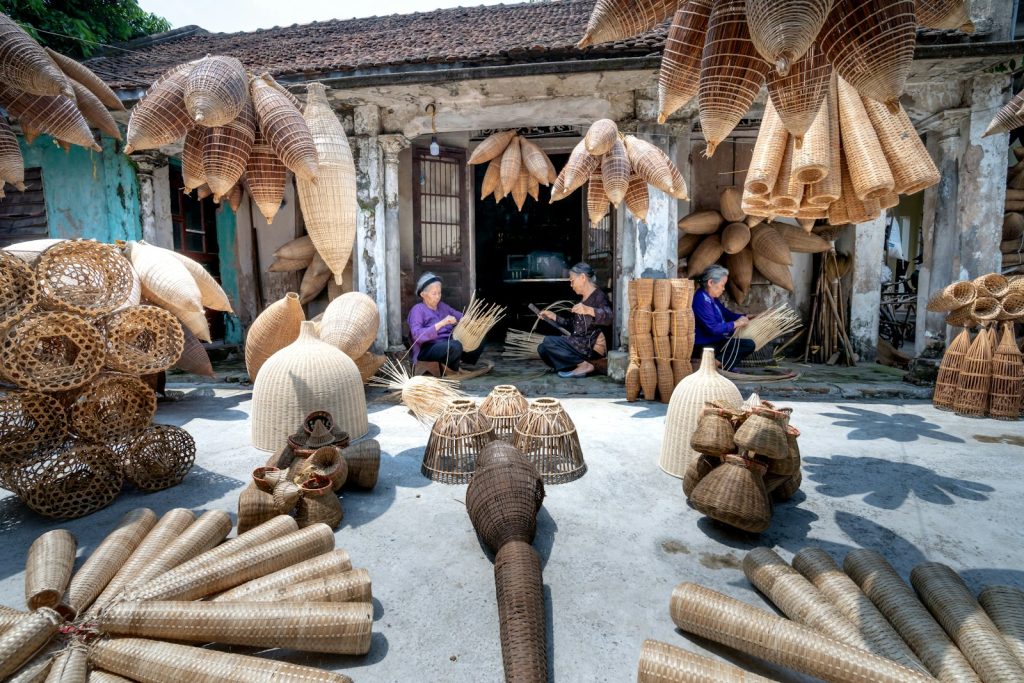
Honest buyer note: Our lamps are handwoven by village artisans in Bali and Java, so expect natural colour variation and a size tolerance of roughly ±1–3 cm on larger shades. All prices, MOQs, lead times and container counts are indicative ranges (2024–2025, FOB Indonesia) and final pricing is by quote. Standard wiring is E27 at 220–240 V; we can supply CE-compliant wiring or shade-only (no electrics) so you meet UL/UKCA or local standards in your market — we don’t imply certification we don’t hold. Natural fibre is moisture-sensitive, so we dry, treat and pack appropriately and recommend acclimatisation on arrival. Rattan is generally not CITES-listed. We coordinate vetted workshops and handle export documentation.
Where rattan comes from Indonesia is simple to explain in trade terms: the raw canes are harvested mainly from natural and managed forests in Kalimantan and Sulawesi, then graded, treated and woven in production hubs on Java and Bali. If you buy handwoven rattan lighting from Bali Rattan Lamps, you are buying lamps made in Bali and Cirebon (Java) using raw rattan sourced from those Indonesian islands further east and north.
In this guide I’ll walk through how Indonesian rattan is grown, harvested, processed and turned into pendant, floor and table lamps for export. The goal is practical: if you understand where and how rattan is sourced, you can read supplier offers more critically, benchmark FOB ranges, and plan your buying around quality, moisture risk and lead times.
What rattan is and why Indonesia matters
Rattan is a climbing palm (family Arecaceae) that grows as a vine through tropical forests. It is not bamboo, and it is not wood. The long, solid cane is peeled, split, bent and woven into furniture, baskets and lighting.
Indonesia is consistently one of the world’s largest sources of raw rattan. The key producing regions are:
- Kalimantan (Indonesian Borneo) – major source of thick canes used for furniture frames and large-diameter weaving.
- Sulawesi – major source of thinner canes used for fine weaving, lamp shades, and smaller decor pieces.
Most of the rattan harvested in Kalimantan and Sulawesi does not stay there. It is traded into Java (especially Cirebon) and Bali for processing and finished goods manufacturing. That is the “raw rattan sourcing” backbone of the Indonesian lighting and furniture industry.
Main sourcing regions: rattan harvest in Kalimantan and Sulawesi
For B2B buyers, tracing rattan harvest Kalimantan Sulawesi helps explain price and quality differences between collections and suppliers.
Kalimantan: thicker canes, heavier frames
In Kalimantan, rattan grows in lowland and hill forests. Thick-diameter species are harvested for:
- Structural frames (armchairs, lounges, heavy baskets)
- Large pendant lamp frames that need more rigidity
- Core that is later peeled or split into smaller sizes
Buyers usually feel the impact of Kalimantan material as:
- Heavier, more rigid bases for floor and table lamps
- Better dimensional stability for oversized pendants
- Slightly higher material cost per unit for frame-heavy designs
Sulawesi: fine weaving grades
Sulawesi is better known for thinner canes and finer weaving grades. These canes are often used for:
- Handwoven shades for pendant and table lamps
- Open-weave patterns that throw decorative shadows
- Tight, more uniform weaving where visual consistency is critical
For lighting buyers, Sulawesi-origin material typically means:
- Lighter products (more economical air-freight samples, easier handling)
- More intricate weaves that photograph well for catalogues
- Higher labour content due to finer splitting and handwork
From forest to factory: the Indonesian rattan chain
Indonesian rattan goes through several stages before it becomes a lamp hanging above your customer’s dining table.
1. Harvesting and primary preparation
- Collection – Local harvesters cut mature canes in the forest and drag or carry them to village collection points.
- Initial cleaning – Outer skin may be scraped; canes are sorted loosely by diameter and length.
- Sun-drying – Canes are typically dried outdoors. This early drying stage is critical for future moisture behaviour.
At this stage, the main risks are:
- Over-drying – Can make canes more brittle, relevant for tight bends in lamp frames.
- Under-drying – Traps moisture and increases mould risk later in containers.
2. Intermediate trading and grading
The canes then move through local traders and into larger warehouses closer to ports and processing hubs.
- Grading – By diameter, straightness, and visible defects.
- Basic treatment – Boiling or steaming, some anti-insect treatment, further drying.
- Baling – Bundled and shipped as raw material to Java/Bali.
This is where raw rattan sourcing economics begin to shape FOB prices for finished lighting. Higher grades and better treatment cost more up front but reduce breakage and scrap rates in weaving workshops.
3. Processing hubs: Cirebon (Java) and Bali
By the time the rattan arrives in our workshops, it has typically passed through two or three traders. In our case:
- Most structural and weaving material is processed in Cirebon, West Java, a long-standing rattan furniture and lighting hub.
- Final weaving, finishing, assembly and packing of Bali Rattan Lamps products happens in Bali and Cirebon, depending on the model.
Key processes here:
- Splitting and peeling canes into the desired width/thickness for each design.
- Heat-bending for frames and ribs of pendant / floor / table lamps.
- Hand weaving and knotting around frames.
- Hand-sanding, clear or coloured finishing, and basic quality control.
This is also the point where moisture content, surface finish and colour consistency are managed as well as possible under handmade conditions.
How rattan sourcing affects lamp quality and variance
Because rattan is a natural and hand-processed material, variance is normal. Understanding the source helps set expectations and product specs.
Colour and surface variation
- Different batches from Kalimantan and Sulawesi can have slightly different base tones (more yellow, more honey, more grey).
- Sun-drying and age of the cane change the final colour after finishing.
- Hand-applied stains or whitewashes may absorb differently on each batch.
Result: within one production batch we aim for consistency, but small tonal variation across reorders is standard in Indonesian rattan. Commercial buyers usually manage this by photographing and selling by batch, and avoiding strict “perfect match” promises to end customers.
Shape and dimension tolerance
- Hand-bent frames can vary by a few millimetres.
- Handwoven shades may not be perfectly symmetrical when measured with a caliper, though the visual impression is round or balanced.
We recommend agreeing tolerances (for example ±5–10 mm on diameter/height for large pendants) in your purchase specifications and QC checklists.
Moisture and mould risk in export containers
Moisture is the main export risk with natural rattan:
- Ambient humidity in Bali/Java is high year-round.
- Rattan continues to exchange moisture with the environment, even after drying.
- Condensation in containers (especially during long sea voyages) can trigger mould if mitigation is weak.
To minimise problems on shipments from Indonesia to the US, EU or Australia, we typically work with buyers on a mix of:
- Extra drying time in the workshop before packing.
- Ventilated or lined cartons, avoiding plastic wrapping directly against rattan unless needed.
- Desiccant packs and container-level moisture absorbers, especially for colder destination seasons.
- Fumigation where required by the importing country’s regulations.
No natural rattan product is “zero risk” for mould, especially on long sea routes. Honest planning and shared packing protocols are more effective than marketing claims.
Trade basics: HS codes, FOB ranges, MOQs and loading
Below is a snapshot of key trade facts for Indonesian rattan lighting, based on our 2024–2025 operations. All prices are indicative FOB Indonesia ranges only, last verified June 2026, always confirmed by quote for your specific design, volume and finish.
| Item | Typical Detail (Indonesia rattan lighting exports) |
|---|---|
| HS code – rattan lamp shades (no electrics) | Commonly classified under HS 9405 (Lamps and lighting fittings); final subheading can vary by destination/broker advice. |
| HS code – lamps with electrics | Also under HS 9405; separating “shade-only” vs wired sets can help simplify certification responsibilities. |
| Indicative FOB range – small/medium pendant shades | Approx. USD 6–18 FOB Indonesia per piece for handwoven rattan shades (without bulb), depending on size, weave complexity and finish (by quote, 2024–2025). |
| Indicative FOB range – large/XL pendant shades | Approx. USD 18–55 FOB Indonesia per piece for oversized or complex designs, high material use (by quote, 2024–2025). |
| Indicative FOB range – table/floor lamps (shade + base, unwired or basic E27 set) | Approx. USD 15–65 FOB Indonesia per piece, depending on height, base material (rattan/wood/iron) and weave complexity (by quote, 2024–2025). |
| Typical MOQ – per design/size/colour | Commonly 50–100 pcs per model/size/colour for export runs. For very large items MOQs can be lower; for micro-variants higher. |
| Lead time – regular orders | Indicative production lead time 8–12 weeks from deposit and final approval, plus shipping time, depending on volume and workshop load (2024–2025). |
| Deposit terms | Many Indonesian rattan exporters work on 30–50% deposit on order, balance against documents or before shipment; exact terms by supplier and order size. |
| Container loading – 20ft | Depending on mix and sizes, roughly 350–800 rattan pendants or 250–550 mixed lamps, with smart nesting and stackable designs. |
| Container loading – 40ft HC | Often 2–2.5x a 20ft’s volume, but efficiency drops for very oversized domes or irregular shapes; packing plans are made per order. |
| Fumigation / phytosanitary | Rattan is a plant material; destination-specific rules apply. Indonesia can provide fumigation and documentation where mandated (e.g. some AU imports). |
| CITES status | Most commercial Indonesian rattan species used for lighting are not listed in CITES at time of writing. Always confirm for any unusual species claims. |
To discuss how these ranges would apply to your designs and volumes, you can plan your trip through an RFQ or WhatsApp discussion. Sharing target landed price, retail band, and preferred markets (US/EU/AU) helps us respond with realistic FOB options and packing approaches.
Wiring, certification and market context (US, EU, Australia)
Most questions about Indonesian rattan lamps are less about the plant and more about the electrics. It is important to separate the two clearly in your buying strategy.
Shade-only vs wired sets
- Shade-only exports: Rattan shades are supplied without cables, lampholders or bulbs. This is often simpler for:
- EU buyers who prefer to use pre-certified CE electrical sets within the EU.
- US/Australian buyers who must handle UL/ETL/SAA compliance locally.
- Wired sets from Indonesia:
- Standard configuration from Bali/Java workshops is usually E27 lampholder, 220–240V supply.
- Some components can carry CE-marked lampholders and cables, but complete-fixture certification is typically arranged by the importer.
For the US and Canada, UL or ETL certification expectations are strict. Many North American buyers prefer shade-only imports and assemble certified kits domestically to keep control over compliance and liability.
Being honest about certification
Bali Rattan Lamps focuses on:
- Supplying rattan shades and structures with consistent build and material quality.
- Offering basic E27/220–240V wiring options and CE-oriented components on request.
- Supporting buyers who choose to handle final certification (UL, ETL, SAA, etc.) in their home market.
We do not market generic “fully certified everywhere” claims. Certification is jurisdiction-specific, model-specific, and must be tied to the actual component set used in your production run.
Environmental facts without greenwashing
Rattan is often described as “eco” or “green” because it is fast-growing and can be harvested without clearing whole forests. There is truth in that, but trade buyers should look for specifics instead of slogans.
What we can factually say
- Rattan is a renewable plant material that matures faster than most timber species used for furniture.
- In Indonesia, it is often harvested from natural or semi-managed forests where it grows as an understory climbing palm.
- It can create economic value from standing forest, which can support arguments against full conversion to monoculture crops.
What we will not say without evidence
- We do not claim blanket “sustainability” or “carbon neutrality” without audited data.
- We only refer to FSC or PEFC where there is genuine, traceable certification for the specific component (for example, wooden bases), and this is always documented order by order.
- We do not use generic green icons or vague labels to sell rattan lighting.
If environmental credentials are central to your brand, we recommend building a transparent narrative around material choice, long product life, repairability, and your own logistics and certification practices, rather than relying solely on the word “rattan”.
Practical buying tips: linking sourcing to your RFQs
Understanding where rattan comes from Indonesia can directly improve your RFQs and purchase contracts.
1. Specify material expectations clearly
- State if you prefer tighter weaves (often more Sulawesi-grade cane, more handwork) or can accept more open, rustic weaves.
- Define acceptable colour range (e.g. “light natural to medium honey, no dark burned patches”).
- Agree on tolerances for diameter, height, and frame roundness in writing.
2. Ask how the supplier manages moisture
- Drying process and duration before packing.
- Use of desiccants inside cartons and containers.
- Any additional anti-mould measures compatible with your market rules.
3. Plan your container mix around real volumes
- Oversized domes and bell shapes burn CBM quickly; consider nesting sizes and stackable forms.
- Combine pendants, small table lamps and accessories to optimise space.
- For first orders, a 20ft test shipment is often a safer way to validate packing density and damage rates.
4. Align wiring strategy to market
- EU / UK: Decide if you want shade-only, or CE-oriented wiring sets assembled in Indonesia. Budget time and cost for any in-market testing.
- US / Canada: Typically best to import shade-only and integrate UL/ETL-listed components locally.
- Australia / NZ: SAA compliance is strict; many buyers either assemble locally or work with specialist importers.
If you would like help turning these points into a structured RFQ (including sizes, pictures, and target FOB ranges), you can plan your trip with us via email or WhatsApp. A precise brief usually saves at least one round of sampling and rework.
FAQs about Indonesian rattan sourcing for lighting
Is Indonesian rattan legal to import and is it covered by CITES?
Most commercial rattan species used in Indonesian lighting and furniture are currently not listed under CITES, so they do not require CITES permits. However, you still need to comply with your national timber or plant product regulations (for example, due diligence rules in the EU or Lacey Act declarations in the US). If a supplier claims a special or rare rattan species, ask for its scientific name and confirm its status with your customs broker.
Does rattan from Kalimantan or Sulawesi affect lamp durability?
Durability in daily use is more influenced by drying quality, weaving skill and design than by which island the cane came from. Kalimantan canes are often thicker and used for frames; Sulawesi canes are often thinner and used for fine weaving. Both can perform very well if properly prepared, dried and woven. Poor drying or weak joinery will cause problems regardless of origin.
Can I get fully UL- or CE-certified rattan lamps directly from Indonesia?
You can source rattan lamps built with CE-oriented components from Indonesia, and in some cases factories cooperate with external labs. But certification is specific to a given model and component set. For UL/ETL (North America) and SAA (Australia), many importers prefer to manage certification in their own country using imported shades and locally sourced electrical kits. We do not claim generic “fully certified everywhere” status for all models.
What is a realistic MOQ and lead time for custom rattan pendants?
For a custom design, a realistic starting MOQ is typically 50–100 pieces per size/finish, with an indicative production lead time of 8–12 weeks after deposit and final sample approval. Very large or complex weaves may require higher MOQs or longer lead times; simple shades may fit at the lower end. These are 2024–2025 indicative figures and are always confirmed by quotation.
Do I need fumigation or phytosanitary certificates for rattan lamps?
Requirements depend on your destination country and product classification. Some markets or specific shipments, especially to Australia, can require fumigation and associated documentation for plant-based goods. Many shipments of finished rattan lamps to other markets proceed under standard customs and sanitary rules without special fumigation, but your customs broker should advise based on HS code and local regulations. Indonesian exporters can arrange fumigation where required.
If you are preparing your first Indonesian rattan lighting order and want to align design, sourcing, FOB targets and compliance from the start, you can plan your trip with us. We are happy to review sketches, mood boards or sample photos over WhatsApp and turn them into a concrete sourcing and export plan.