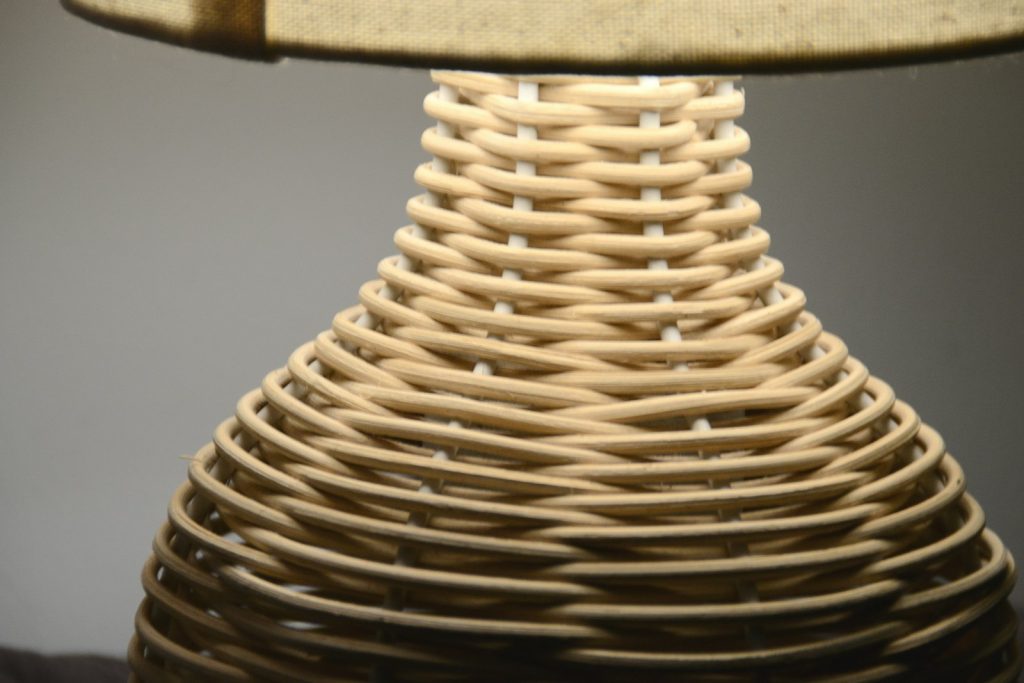
Honest buyer note: Our lamps are handwoven by village artisans in Bali and Java, so expect natural colour variation and a size tolerance of roughly ±1–3 cm on larger shades. All prices, MOQs, lead times and container counts are indicative ranges (2024–2025, FOB Indonesia) and final pricing is by quote. Standard wiring is E27 at 220–240 V; we can supply CE-compliant wiring or shade-only (no electrics) so you meet UL/UKCA or local standards in your market — we don’t imply certification we don’t hold. Natural fibre is moisture-sensitive, so we dry, treat and pack appropriately and recommend acclimatisation on arrival. Rattan is generally not CITES-listed. We coordinate vetted workshops and handle export documentation.
Rattan pendant weave styles are simply the different ways rattan strands are braided, coiled or latticed around a frame to form a lampshade. For buyers, understanding rattan pendant weave styles means you can brief factories precisely, predict light output and price points, and avoid surprises once the container lands.
What “weave style” really means in rattan pendants
In the Bali and Cirebon workshops we work with, “weave style” covers four linked choices:
1. Material & profile – round-core rattan, flat peel, split, or mixed; sometimes blended with bamboo or seagrass.
2. Weave pattern – open lattice, loose basket, semi‑tight “faux wicker”, or very tight wicker.
3. Structure – wrapped onto a welded metal frame, or fully free-form (frame-less basket or coil).
4. Finish – raw/natural, lightly stained, or fully painted/washed.
Change any of these and you change the look, light pattern, labour time, QC complexity and FOB.
Below I’ll walk through the main types of rattan lamp weave, how they are actually produced in Bali and Java, how they behave in real projects, and what to expect on lead times, MOQs and pricing.
Main rattan pendant weave styles used in export
1. Open lattice weave (airy, shadow‑casting)
This is the workhorse of coastal and boho projects.
How it’s made in Bali/Java
– Weavers use round-core rattan 2–4 mm thick, sometimes mixed with split rattan.
– A metal skeleton (rings + ribs) is welded first in Cirebon or Gianyar, then hand‑wrapped.
– Strands are crossed at wide intervals, creating “windows” 10–40 mm apart.
– Common patterns: diagonal criss-cross, hex lattice, or loose “birdcage” loops.
Effect on light
– Very transparent; you see the bulb.
– Strong shadow play on walls and ceilings.
– Best with E27 filament or LED vintage bulbs (220–240 V in our standard builds).
Where it’s used
– Hospitality: beach clubs, open lobbies, restaurants that want visible bulbs.
– Retail: feature clusters over counters.
– Residential: living rooms/dining, often in staggered sizes.
Pros
– Lower material use vs tight wicker.
– Dries faster in finishing, so slightly lower mould risk during production.
– Lighter weight → easier ceiling mounting and more units per CBM in a container.
Cons
– You must manage glare with bulb choice.
– Electrical hardware is more visible, so neat wiring is non‑negotiable.
– Less “polished” than tight wicker in very formal interiors.
2. Semi‑open basket weave (balanced look & light)
This is the middle ground between open weave vs tight wicker.
How it’s made
– Often flat rattan peel or 3–5 mm split rattan, occasionally mixed with seagrass.
– Weavers work over a frame or directly on a mould (for drum or bell shapes).
– Weave spacing is tighter than lattice but not fully closed, with 3–10 mm gaps.
– Patterns: over‑under basket weave, simple herringbone, vertical cage with horizontal binders.
Effect on light
– Softer, more diffused than lattice.
– Still some patterning, but less harsh shadows.
– Bulb is partially veiled, but not fully hidden.
Use cases
– Casual dining, cafes, mid‑market hotels.
– Rooms that need some ambience without fully hiding the lamp.
Pros
– Good compromise on price vs look; labour is moderate.
– Imperfections are less visible than on tight wicker.
– Works in many interior styles (Scandi, Japandi, boho, coastal, rustic).
Cons
– Still not as “finished” as tight wicker for high‑end formal projects.
– Requires reasonably consistent strip width for a clean pattern.
3. Tight wicker weave (refined, diffused light)
This is what many buyers mean by “premium rattan shade”.
How it’s made
– Fine peel or split rattan, often 1.5–3 mm wide, pre‑sorted by thickness and colour.
– Weavers work very close together; gaps are minimal or non‑existent.
– May be woven over a plyboard or metal form to keep dimensions strict.
– Patterns: tight over‑under, diagonal cane, complex basketry.
On the ground, this is the slowest work. An experienced artisan in Cirebon might finish one Ø45 cm tight wicker dome in a day; a looser lattice piece might take half that.
Effect on light
– Soft, even glow. The bulb is heavily diffused.
– Minimal shadow patterns; more like a fabric shade.
– Excellent for restaurants, hotel rooms, lounges.
Use cases
– 4–5 star hospitality.
– Residential clients who want rattan but not the strong boho lattice look.
– Projects needing mix‑and‑match floor, table and pendant shades with the same weave.
Pros
– Most “finished” and furniture‑grade appearance.
– Hides bulbs and hardware well.
– Higher perceived value at retail.
Cons
– Highest labour → higher FOB.
– More risk of tension‑related warping if humidity swings after loading.
– QC must catch loose tails and inconsistencies.
4. Coil and spiral weave (sculptural, free‑form)
Some of the most photographed Bali pendants are actually coil‑built, not framed.
How it’s made
– Thick rattan core (often 4–8 mm) is coiled in spirals.
– Each coil is stitched to the previous with finer rattan lashings.
– No metal frame: the structure is self‑supporting.
– Common in organic “onion”, “gourd”, or asymmetric cloud shapes.
You’ll see this in several Bali beach clubs and restaurants; it’s still handmade in Java as well.
Effect on light
– Semi‑open, mixed: the thicker ribs block more light, lashings allow some sparkle.
– Shadows are organic and irregular.
Pros
– Very distinctive; good for branding and photo‑driven venues.
– No metal means no frame rust, but rattan itself can still absorb moisture.
Cons
– Harder to stack efficiently → lower pack density per CBM.
– Shape variance between units is higher.
– Slightly more fragile in shipping without good internal packing.
5. Mixed rattan–seagrass or rattan–bamboo weaves
Not strictly a “style” by pattern, but a material mix that affects cost and performance.
How it’s made
– Structural elements are rattan (frame + main ribs).
– Decorative wrap or sections are sun‑dried seagrass or bamboo strips.
– Often used in semi‑open basket patterns.
Light behaviour
– Similar to semi‑open basket, but seagrass slightly warms the colour temperature of emitted light.
– Bamboo strips can create sharper lines if cut flat and even.
Pros
– Distinctive texture and colour without heavy staining.
– Slight material cost benefit in some mixes.
Cons
– Seagrass is more moisture‑sensitive than rattan; export packing must be very dry.
– Mixed materials can age at different speeds (colour shift).
Open weave vs tight wicker: how they compare for projects
Below is an at‑a‑glance comparison of the two ends of the spectrum. These are generalised from Bali and Cirebon workshop output.
| Aspect | Open / Lattice Weave | Tight Wicker Weave |
|---|---|---|
| Light output | Very bright, strong shadows, visible bulb | Soft, diffused, minimal shadows |
| Typical material | Round core 2–4 mm, some split | Fine peel/split 1.5–3 mm, carefully graded |
| Labour time per Ø40–45 cm shade | Lower (faster to weave) | Higher (slow, detailed work) |
| Indicative 2024–2025 FOB range* (medium sizes) | US$7–14 / piece by quote | US$12–26 / piece by quote |
| Moisture sensitivity | Lower (more airflow through weave) | Higher (dense weave holds moisture longer) |
| Best use | Beach clubs, casual F&B, boho/coastal retail | Hotels, refined dining, premium retail lines |
| Defect visibility | Small defects more forgiving | Inconsistencies more obvious |
*FOB ranges are indicative for 2024–2025, ex Bali or Tanjung Priok (Jakarta), and depend on design complexity, size, finish, and order volume. Final pricing is always by quote.
If you need help matching weave style to your project brief, you can plan your trip or WhatsApp our trade desk to review drawings, photos, and target FOB ranges together.
Technical facts: sizes, HS codes, MOQ, containers
Below is a compact fact sheet we use with many first‑time wholesale rattan lighting buyers.
- Typical pendant diameters for export
- Small: 20–30 cm; Medium: 35–45 cm; Large: 50–70 cm; Oversize feature: 80–120 cm (subject to container door height and packing strategy).
- Common heights
- Proportional to diameter; e.g., Ø40 cm dome ~30–35 cm high, Ø60 cm bell ~40–50 cm high.
- Material origin
- Rattan cane largely sourced from Kalimantan and Sulawesi; weaving and finishing primarily in Bali and Cirebon (West Java).
- HS code (typical)
- Generally shipped under HS 9405 (lamps and lighting fittings) or HS 4602 (baskets and wickerwork) depending on if supplied wired or as shades only. Final classification is agreed with your forwarder/customs broker.
- MOQ (by design)
- Most workshops need 30–50 pieces per size/colour for simple open weaves; 50–100 pieces per size/colour for tight wicker or complex forms. Mixed containers across designs are possible.
- Lead time (2024–2025)
- Sampling: 3–5 weeks depending on complexity. First PO: commonly 8–12 weeks from deposit to ex‑factory, depending on volume, wet season timing and finishing load.
- Indicative FOB 2024–2025
- Small pendants (20–30 cm): approx. US$4–10; Medium (35–45 cm): US$7–18; Large (50–70 cm): US$12–32; Oversize (80+ cm): US$24–60+, all by quote and strongly dependent on weave density and frame complexity.
- Container loading
- For a 40′ HC, mixed rattan lighting loads often range from ~600 to 1,500+ pieces depending on nesting, size mix, and cartonisation. Very tight or fully framed forms reduce nesting efficiency.
- Wiring
- Standard export builds from our network use E27 lampholders, 220–240 V, with CE‑oriented components for EU/UK and many international markets. For North America, most B2B buyers import shades only and fit UL‑listed kits locally; full UL assembly is generally arranged by the buyer with their own facility or partner.
How weave style affects cost & logistics
1. Material usage and labour
– Open lattice uses less rattan and fewer weaving hours → lower FOB, higher unit counts per container.
– Tight wicker consumes more, especially fine peel that must be pre‑processed and graded → higher FOB, fewer units per CBM (heavier and often less nestable).
– Coil/organic forms are particularly labour‑heavy because there’s no frame acting as a jig; the artisan constantly corrects shape by hand.
In practice, moving from an open lattice dome to a similar‑sized tight wicker dome can add 30–80% to piece‑rate labour costs before overhead.
2. Shape and nesting (packing efficiency)
Weave choice often dictates frame shape:
– Simple open baskets and domes nest easily.
– Tight wicker over complex or angular frames nests poorly and needs more protection → more cartons, more cube.
– Coil and sculptural forms with large overhangs need custom internal supports to avoid crush damage.
For a project with tight landed‑cost targets, we often recommend:
– Open or semi‑open basket weaves for larger diameters (60–90 cm) so we can stack them aggressively.
– Tight wicker reserved for small/medium pendants and table/floor lamps, where cube impact is smaller.
3. QC and handmade variance
All rattan pendants from Bali and Cirebon are hand‑woven. That reality matters differently for each weave style:
– Open lattice: Slight variance in angle or spacing is usually visually acceptable.
– Semi‑open basket: Warp or twist is more noticeable, but small differences blend in at height.
– Tight wicker: Millimetre‑level inconsistencies stand out, especially on straight‑sided cylinders or drums.
On export runs we typically allow, and you should plan for:
– Size variance: ~±1–2 cm on small/medium, slightly more on large/organic shapes.
– Colour variance: Natural rattan tones shift between batches and even within the same PO after staining or clear coat.
If you need very strict dimensional control (e.g., fitting into metal rings on site), specify tolerances in your RFQ so the workshop can choose appropriate jigs and QC steps.
Moisture, mould and finish: what weave style changes
Rattan is a natural, hygroscopic material. It reacts to humidity in Bali, in the container, and in your warehouse.
Open vs tight weaves in humid conditions
– Open lattice and semi‑open basket
– More airflow; pieces dry faster after staining or clear coat.
– Marginally lower mould risk during production.
– In containers, still need proper drying and desiccants.
– Tight wicker
– Holds moisture longer if finishing/curing is rushed.
– If loaded slightly damp and shipped through humid or cold routes, risk of surface mould spots increases.
– These are usually cosmetic (wipeable) but can be a headache on arrival.
Most serious exporters in Bali and Cirebon now:
– Air‑dry or kiln‑finish rattan components before weaving.
– Allow curing time after staining/sealing.
– Use desiccant bags and sometimes container liners for long routes.
If your market has strict QA on organic materials, build a small buffer in lead time so production isn’t forced to pack before pieces are fully dry, especially during the rainy months.
Finish choices by weave style
– Raw / clear coated – Keeps the most natural look; popular across weave styles.
– Light stain (honey, teak, walnut) – Hides some colour variation; tight wicker takes stain more evenly.
– Paint / wash (white, black, custom) – Demands very clean weaving; drips or pooling are more visible in tight patterns. Open weaves can show paint on inner surfaces if QC is sloppy.
Specify if you prefer a visible grain (thin stain) or a more opaque coverage, and send physical swatches where possible.
Wiring, certification and shade‑only options
The weave you choose does not change the core electrical facts, but it changes heat and visibility.
– Most export pendants we handle ship with E27, 220–240 V lampholders and basic cable + ceiling rose kits aligned to CE expectations for EU/UK installers.
– For North America, many importers order shade‑only pendants and handle wiring in their own UL‑certified facilities or via regional partners. Full UL sets direct from Indonesian workshops are still the exception, not the rule.
– For very tight wicker or small enclosed forms, specify LED‑only usage on your packaging and product data to keep operating temperatures low.
If you brief us clearly (market, voltage, desired certification path), we can match you with workshops used to that configuration, or recommend shade‑only shipping and local wiring.
Choosing rattan pendant weave styles for your range
For wholesalers and project buyers, a balanced collection usually combines multiple weave densities:
– Entry price / volume SKUs
– Open lattice domes and bells in 2–3 diameters.
– Semi‑open basket cylinders that stack efficiently.
– Mid‑tier
– Semi‑tight wicker in popular shapes (drums, ovals) that can double as table/floor lamp families.
– A few coil or organic pieces as upsell feature items.
– Premium tier
– Tight wicker or complex basketry, possibly in stained or painted finishes.
– Oversize feature pendants (single or cluster) where labour is the selling point.
We can help you build this tiered approach against target landed costs and your market expectations. If you’d like to see sample photos, typical size runs and current 2024–2025 FOB ranges from our network, you can plan your trip or message our team on WhatsApp for a working catalogue and RFQ support.
FAQs on rattan pendant weave styles
Which rattan pendant weave style gives the softest light?
Tight wicker gives the softest, most diffused light because the weave is nearly closed and acts like a shade fabric. Semi‑open basket weaves are a close second. Open lattice throws stronger shadows and leaves the bulb more exposed.
Are open weave pendants always cheaper than tight wicker?
Usually, but not always. Open lattice uses less material and time, which tends to lower FOB, especially in simple shapes. However, very large or complex framed open designs can cost more than small tight wicker pieces. Final 2024–2025 FOB is always by quote based on size, complexity and volume.
Can I use rattan pendants outdoors?
Standard Bali and Cirebon rattan pendants are built for covered, dry spaces. Light occasional humidity is fine, but direct rain and prolonged outdoor exposure will shorten their life and encourage mould or cracking. For semi‑outdoor use, many buyers specify covered terraces and use shade‑only pendants with locally rated outdoor wiring sets.
Is rattan subject to CITES or special export permits?
Rattan used in Bali and Cirebon lighting is generally not listed under CITES, so it does not require the same permits as many timbers. Standard export documentation still applies, and your customs broker will classify under HS 9405 or 4602 depending on configuration.
Can you match an existing weave pattern from a sample?
In many cases yes, especially for common basket, lattice and wicker patterns. We usually need a physical sample or detailed photos with dimensions to reverse‑engineer the frame and weave count. From there we can give you a 2024–2025 FOB range, MOQ by size, and sampling lead time. Send your reference via email and we can follow up quickly from our plan your trip page or via WhatsApp.