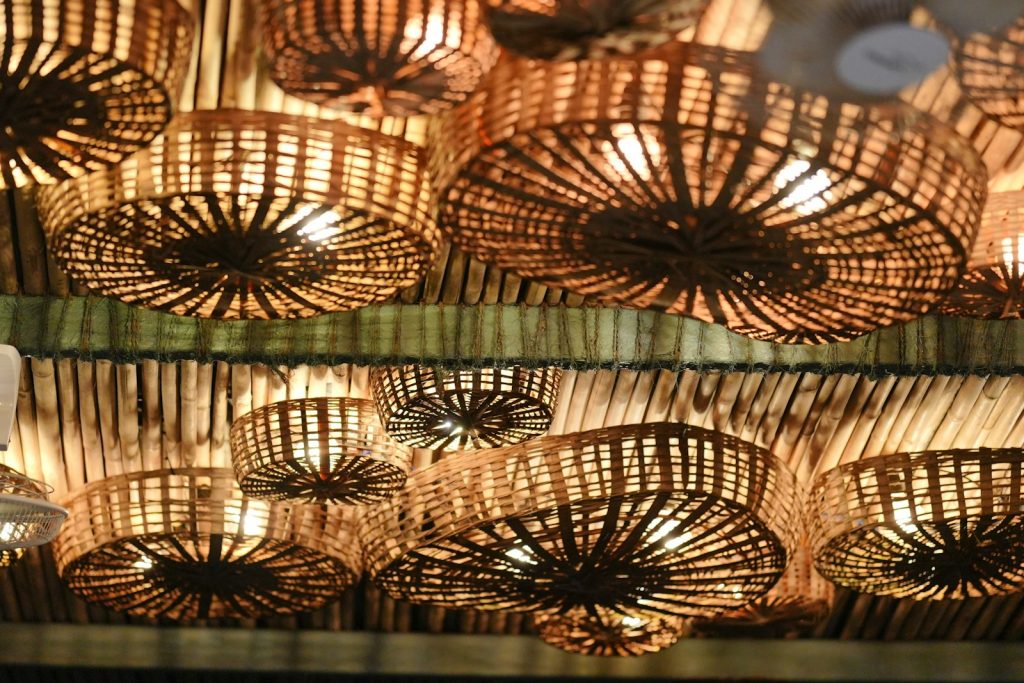
Honest buyer note: Our lamps are handwoven by village artisans in Bali and Java, so expect natural colour variation and a size tolerance of roughly ±1–3 cm on larger shades. All prices, MOQs, lead times and container counts are indicative ranges (2024–2025, FOB Indonesia) and final pricing is by quote. Standard wiring is E27 at 220–240 V; we can supply CE-compliant wiring or shade-only (no electrics) so you meet UL/UKCA or local standards in your market — we don’t imply certification we don’t hold. Natural fibre is moisture-sensitive, so we dry, treat and pack appropriately and recommend acclimatisation on arrival. Rattan is generally not CITES-listed. We coordinate vetted workshops and handle export documentation.
Rattan lamp moq deposit lead time refers to the minimum order quantity, upfront payment percentage, and production timeline that factories and workshops require for wholesale rattan lighting. For B2B buyers, understanding these three levers is the core of getting realistic quotes, accurate landed-costs, and reliable delivery dates.
At Bali Rattan Lamps, we keep this practical and numeric. This page breaks down typical minimum order rattan lamps requirements, common rattan lighting deposit terms, standard lead times, and how all of this fits into FOB pricing and container planning for 2024–2025 shipments.
What MOQ, Deposit & Lead Time Mean in Rattan Lamp Sourcing
MOQ (Minimum Order Quantity)
MOQ is the smallest order a workshop will accept for a SKU, a mixed model order, or a shipment value/volume. In rattan lighting, MOQ is usually set to cover:
- Set‑up time for weaving and frames
- Minimum raw rattan bundle purchases
- Economical packing and container use
Most rattan lamp suppliers in Bali and Java will define MOQ in three layers:
- Per model/size – e.g. 20–50 pcs per size per design for pendants
- Per order – e.g. total 50–150 pcs mixed models per shipment
- Sometimes by value – e.g. minimum FOB USD X,XXX per shipment (by quote only)
Deposit (Advance Payment)
The deposit is the portion of your order value paid before production begins. For Indonesian rattan lighting, the standard pattern is:
- 50% deposit on proforma invoice to confirm order and buy materials
- 50% balance after goods are finished, QC‑checked and ready to load, but before release of documents
Some long‑term buyers may negotiate 30/70 terms or partial balance against copy B/L, but that is relationship and volume dependent and always by individual agreement.
Lead Time (Production + Prep)
Lead time is the period from deposit receipt to cargo ready date (CRD) at the FOB port. For hand‑woven rattan lamps, this timeline must include:
- Frame work (if metal/bamboo frame is used)
- Weaving and trimming
- Drying and moisture equalisation
- Finishing (stain/clear coat) and final drying
- Packing, labeling and container loading slot
Realistic lead times are strongly affected by order size, peak season, and weather (humidity slows drying). The ranges below assume normal conditions and standard volumes.
Indicative Rattan Lamp MOQ, Deposit & Lead Time (2024–2025)
All ranges below are indicative only, based on current conditions in Bali and Cirebon (Java) workshops and freight out of Indonesian ports. Every project still needs a specific quote.
| Item | Typical Range (Last Verified June 2026) | Notes |
|---|---|---|
| MOQ per pendant lamp model/size | 20–50 pcs | Small shades at lower end; very large/custom shapes at higher end |
| MOQ per floor or table lamp model | 10–30 pcs | Lower count because volume per piece is larger |
| Mixed‑model order MOQ | 50–150 pcs total | Can mix sizes and designs within one shipment |
| Deposit | 40–50% of order value | 50% most common; 40% possible for repeat orders |
| Balance payment | 50–60% before shipment | After final QC and packing; before BL and original docs |
| Lead time – repeat order, 1×20’ mixed pendants | 6–9 weeks from deposit | Production + packing to FOB Surabaya/Benoa |
| Lead time – new designs or large 40’HC | 9–14 weeks from deposit | Sampling and pattern‑making add time |
| FOB price range – small/medium pendant shades | FOB USD 8–28/pc | Size, weave complexity, finishing and hardware affect price |
| FOB price range – large statement pendants | FOB USD 28–95/pc | Oversize pieces occupy more CBM per unit |
| FOB price range – floor & table lamps (shade + base) | FOB USD 22–85/pc | Depends on materials (rattan only vs rattan + wood/metal) |
All prices are FOB Indonesia, 2024–2025, by quote only, and will move with material, labour and freight conditions. For a project‑specific range, share your target sizes, designs and approximate quantities via plan your trip — we are happy to walk through scenarios on WhatsApp before you commit to a formal RFQ.
How MOQ Works for Different Rattan Lamp Types
Pendant Lamp MOQ
Pendants are the core category for export rattan lighting. Typical patterns:
- Simple open‑weave pendants (e.g. basic basket, dome, drum shapes)
- MOQ: 20–30 pcs per size per design
- Rationale: Faster weaving, less frame work, lower material risk
- Complex or dense weaves (e.g. tight cane, double‑layer, sculptural forms)
- MOQ: 30–50 pcs per size per design
- Rationale: More hours per piece; sample and jig set‑up need to be amortised
- Extra‑large pendants (e.g. >70–80 cm diameter, tiered chandeliers)
- MOQ: 10–20 pcs, but CBM per piece is high
- Container loading becomes the main efficiency driver, not piece count
Floor & Table Lamp MOQ
Floor and table lamps combine rattan shades with wood, rattan, or metal bases.
- Table lamps
- MOQ: 15–30 pcs per model
- Smaller CBM per piece; easy to mix with pendants in one shipment
- Floor lamps
- MOQ: 10–20 pcs per model
- Stability and wiring layout need more engineering, so sampling is key
MOQ for Custom & OEM Rattan Lighting
Custom work needs realistic volumes. As a rule:
- New custom design, minor modification of our line: 20–30 pcs per size
- Fully OEM (your drawing, new frame, new weave): 30–50 pcs per size
- Large architectural feature pieces: case‑by‑case – MOQ by project rather than by piece
We normally prototype in 1–3 samples, adjust, then confirm production MOQ. Sampling cost is credited or partly credited on later bulk orders only if pre‑agreed in writing.
Deposit Terms & Risk Management for Rattan Lighting
Standard Rattan Lighting Deposit Terms
For B2B wholesale, typical rattan lighting deposit terms from Bali and Java are:
- 50% deposit by bank transfer (TT) on signed proforma invoice
- 50% balance after final QC, image/video confirmation, and packing list; before release of original documents
For buyers working through buying agents, the agent may hold funds or charge a service commission. Those arrangements sit outside the factory’s own terms.
Alternative Payment Structures (By Negotiation)
Under certain conditions (long‑term relationship, large volume, or through a trusted trading company) some variations exist:
- 40/60 instead of 50/50 for repeat orders
- LC at sight – less common for crafts due to admin cost vs order value
- Staggered production + payment – for very large projects split into batches
All of these impact pricing and scheduling. Lower deposits generally mean slightly higher unit prices or tighter MOQs because the workshop carries more risk.
Practical Steps to Reduce Payment Risk
On both sides, risk can be managed with structure and transparency:
- Use clear, itemised proforma invoices with HS codes and Incoterm (FOB)
- Lock in agreed tolerances on size/colour and acceptable handmade variation in writing
- Request mid‑production photos/video for large or custom orders
- Use third‑party pre‑shipment inspection if you do not have your own team in Indonesia
Lead Time Planning: From Deposit to FOB Port
Base Production Lead Times
For hand‑woven rattan with drying steps, realistic production windows are:
- Small/medium pendants (mixed models, 50–200 pcs): 6–9 weeks
- Large pendants / floor lamps / mixed container: 8–12 weeks
- Custom or OEM designs: Add 2–4 weeks for sampling and approvals
Seasonality & Weather Effects
Two elements strongly affect lead time:
- Rainy season / high humidity – slows drying, and cautious workshops stretch timelines to reduce mould risk.
- Peak export season – pre‑summer for the US/EU and pre‑Christmas; weaving capacity and container slots tighten.
Building a 2–3 week buffer into your schedule is advisable for orders shipping in those windows.
Logistics Time on Top of Production
Lead time numbers above stop at FOB cargo ready date. You still need to add:
- 1–3 days for local trucking and port in‑gate
- 7–35 days ocean transit depending on route and destination
- Customs clearance and domestic trucking in your country
Always work backwards from your required in‑warehouse date.
FOB Pricing, Container Loading & HS Codes
Typical FOB Price Ranges (By Quote, 2024–2025)
From our own and peer factories’ exports, indicative FOB ranges from Indonesia for hand‑woven rattan lamps are:
- Small/medium pendant shades (approx. 25–45 cm dia): FOB USD 8–28/pc
- Large pendants (approx. 50–80 cm dia): FOB USD 28–95/pc
- Floor lamps (shade + base): FOB USD 35–85/pc
- Table lamps (shade + base): FOB USD 22–65/pc
Key price drivers:
- Rattan grade and thickness; mix of rattan peel, kubu grey, or synthetic fibre
- Weave density, pattern complexity and double‑layer structures
- Presence and complexity of internal frames (bamboo, wire, steel)
- Finishing: natural, washed, stained, or colour painted
- Whether shipped as shades only or with bases and/or electrical sets
Container Loading – How Many Rattan Lamps per Container?
Because rattan lamps are voluminous and relatively light, cubic metre (CBM) is the main constraint, not weight. The figures below assume nested packing where possible, export cartons, and typical mixes of pendant sizes. Actual loading plans require final dimensions.
- 20’ Container (approx. 28 CBM usable for rattan lamps)
- Indicatively 250–450 mixed pendant shades, depending on size and nesting; fewer if many >60 cm diameter.
- 40’ Container (approx. 58–60 CBM usable)
- Indicatively 550–900 mixed pendants; or 200–350 if dominated by large statement pieces and floor lamps.
- 40’HC Container (approx. 65–68 CBM usable)
- Indicatively 650–1,050 mixed pendants; best choice for chain‑store or multi‑project loading.
For floor and table lamps, CBM per piece is much higher. It is common to combine them with shades in one container for better utilisation. For any serious RFQ, we prepare draft packing plans for you so you can model landed cost per unit accurately.
HS Codes for Rattan Lamps
Exact HS classification is the importer’s responsibility, but common codes used for rattan lighting products include:
- 9405.10 / 9405.20 – electric lamps and lighting fittings (if exported wired and complete, depending on destination rules)
- 9405.99 – parts of lamps and lighting fittings (for shades only, widely used for rattan pendants shipped without electrics)
- 4602.x series – basketwork and wickerwork of vegetable materials (sometimes used where customs officers treat shades as basketware rather than lighting)
Discuss HS codes with your customs broker in the US, EU, UK or Australia before finalising labels and commercial invoices.
Wire, Plug & Certification: Being Honest About Rattan Lighting Electrics
Shade‑Only vs Wired Export
Many serious importers prefer to buy shade‑only rattan pendants and then add certified electrical kits at destination. Reasons:
- Local compliance with UL (US/Canada), CE (EU), SAA (Australia/NZ), UKCA (UK)
- Flexibility to match different ceiling canopies, cords and dimming setups
- Simpler product liability management at retail
Where sets are included at origin, typical configuration from Indonesian factories is:
- E27 lamp holder
- 220–240V rating as standard (Indonesia grid)
- Basic 2‑core or 3‑core cable and canopy, non‑UL
This may be acceptable for certain markets and project types, but it is not equivalent to a fully certified UL system for North America. For the US and Canada, buyers typically either:
- Import as non‑electrical decorative shades only, or
- Have a local partner or lab evaluate and list the full fixture to UL/ETL standards
CE, SAA, UL – No Over‑Promising
Rattan lamps themselves (the woven shade) are not CE or UL products; certification attaches to the complete electrical fixture. Indonesian workshops do not, by default, hold whole‑fixture UL listings for OEM customer brands. For:
- EU/UK – you can often combine Bali‑made shades with CE‑marked electrical kits procured in Europe.
- Australia/NZ – use SAA‑approved sets and follow local electrician rules.
- US/Canada – work with a UL/ETL specialist on your side, or keep imports as non‑electrical.
We do not claim blanket CE/UL approvals. Any factory that does should be ready to show current test reports and scope, and you should still verify applicability to your exact SKU and market.
Material Origins, Sustainability & Compliance
Where the Rattan Comes From
Most export‑grade natural rattan used in Bali and Cirebon lighting workshops is sourced from:
- Kalimantan (Borneo)
- Sulawesi
Final weaving and finishing are then done in Bali and on the north coast of Java (Cirebon area), which are Indonesian hubs for rattan handicraft exports.
CITES & Timber Legality
Most commercial rattan species used for furniture and lighting are not listed under CITES. However, regulations can change and different species may fall under different rules. Your customs broker should check current requirements if your government has specific plant‑product import controls.
Indonesia has its own timber legality framework for wood products; for rattan it is generally less complex, but some buyers will still ask for origin statements or basic traceability. These can usually be provided at batch level, not plantation level.
No Greenwashing: FSC, PEFC & “Eco” Claims
Unless a specific product line is backed by valid certificates, branded FSC or PEFC claims should not be made. Many small and medium rattan workshops do not hold those certifications. Rattan is a rapidly renewable, forest‑linked material, but that alone does not equal certified sustainable forestry under these schemes.
If your brand or retailer needs certified material or detailed environmental documentation, raise this early in the RFQ so we can confirm what is and is not possible for that project.
Managing Handmade Variance, Moisture & Quality
Size, Shape & Colour Variance
Rattan lamps are hand‑woven. Even with experienced weavers and jigs, typical tolerances are:
- Dimensions: ±1–2 cm on small pieces; ±2–3 cm on large pieces
- Colour: Natural and washed finishes will vary between production batches and even within a single lamp
- Weave tightness: Slight pattern irregularities are normal; they are not analogous to plastic injection products
For strict hospitality or chain‑store specifications, we align on acceptable tolerances in writing and may suggest design tweaks that reduce visual impact of small variations.
Moisture & Mould Risk in Transit
Rattan is a natural fibre that reacts to humidity. Main risk points:
- Insufficient drying before finishing
- High humidity during finishing and packing
- Condensation inside containers (especially during long, temperature‑variable routes)
Mitigation steps usually include:
- Extended air drying and rack‑storage before final QC
- Use of desiccant packs in cartons and inside containers
- Ventilated or breathable packing where compatible with your retail packaging needs
- Clear instructions for warehouse storage on arrival: cool, dry, off the floor, un‑containerised quickly
Mould cannot be completely “guaranteed away” for any natural fibre product shipped across oceans, but good practice significantly reduces incidents.
Putting It Together: How Buyers Should Plan MOQ, Deposit & Lead Time
For New Importers or Brands
- Start with shade‑only pendants at mixed MOQ (50–150 pcs) to learn the category.
- Accept standard 50/50 payment terms until you build volume and trust.
- Plan for 8–12 weeks from deposit to FOB on your first order, plus ocean time.
- Invest in one pre‑shipment inspection – it usually costs less than one damaged pallet.
For Established Importers & Retail Chains
- Lock in annual or seasonal forecast volumes and then release POs in batches.
- Use 40’HC containers to standardise CBM and pricing assumptions.
- Consider framework pricing bands instead of per‑SKU negotiation each time.
- For wired products, separate shade supply from electrical kit sourcing if your compliance regime is strict.
If you are mapping an assortment or project right now, we can help benchmark realistic MOQ, deposits and lead times against your launch dates. Share your target SKUs and timing via plan your trip; we are comfortable discussing early sketches or Open‑to‑Buy frameworks over WhatsApp before you commit to full tech packs.
FAQs: Rattan Lamp MOQ, Deposit & Lead Time
What is the typical minimum order rattan lamps quantity for export?
Most exporters of rattan lamps from Bali and Java work with MOQs of about 20–50 pieces per pendant lamp model/size and 10–30 pieces per floor or table lamp model, with a mixed‑order minimum of roughly 50–150 pieces per shipment. Exact figures depend on design complexity, size and how many different SKUs you combine in one order.
How much deposit is standard for rattan lighting orders?
The most common rattan lighting deposit terms are 50% down payment on proforma invoice and 50% balance before shipment, after final QC and packing. Some repeat buyers may agree to 40/60 or other variations by negotiation, but 50/50 is the default for 2024–2025.
How long is the lead time for rattan lamps from Indonesia?
For standard designs, you should plan 6–9 weeks from deposit to FOB cargo ready date for a mixed 20’ container of pendants, and 8–12 weeks for larger or more complex orders. Custom designs or first‑time projects usually need an additional 2–4 weeks for sampling and approvals, plus ocean transit and customs time on top.
Can I order rattan pendant lamps with UL‑certified wiring?
Indonesian factories normally supply shades only or basic E27, 220–240V electrical sets that are not UL listed. For UL compliance in the US and Canada, most importers either import shades only and add UL‑listed kits locally, or work with a certification partner at destination. No factory should claim general UL certification for all OEM rattan lamps without specific, current documentation for each listed model.
Are rattan lamps covered by CITES or special wildlife regulations?
Common commercial rattan species used in lighting and furniture are generally not listed under CITES, so CITES permits are typically not required. However, plant‑product import rules differ by country and may change. Your customs broker should confirm the current status for your HS code and destination before shipment.
If you need a detailed quote or want to test MOQ, deposit and lead‑time scenarios against your next season, contact us with your target range via plan your trip. We can review your brief, share indicative FOB bands and talk through WhatsApp to make sure your numbers and timelines are realistic before you lock in a PO.