Honest buyer note: Our lamps are handwoven by village artisans in Bali and Java, so expect natural colour variation and a size tolerance of roughly ±1–3 cm on larger shades. All prices, MOQs, lead times and container counts are indicative ranges (2024–2025, FOB Indonesia) and final pricing is by quote. Standard wiring is E27 at 220–240 V; we can supply CE-compliant wiring or shade-only (no electrics) so you meet UL/UKCA or local standards in your market — we don’t imply certification we don’t hold. Natural fibre is moisture-sensitive, so we dry, treat and pack appropriately and recommend acclimatisation on arrival. Rattan is generally not CITES-listed. We coordinate vetted workshops and handle export documentation.
Most buyers asking “where are Bali rattan lamps made” assume one island, one workshop. In reality, most “Bali” rattan lighting is designed or assembled in Bali but woven in Java (especially Cirebon), using raw rattan shipped from other Indonesian islands.
This page lays out how that supply chain actually works for handwoven pendant, floor and table lamps: Bali vs Java roles, material origins, what “Cirebon rattan lighting” really means, and what you can expect on pricing, lead times and export logistics.
Short answer: “Bali rattan lamps” are usually multi-island products
In trade language, “Bali rattan lamps” is a style and sourcing hub label more than a strict origin stamp.
- Design & brand base: Often Bali (Canggu, Kerobokan, Ubud, Denpasar).
- Main weaving clusters: Java, especially around Cirebon, Tegal, Demak, and sometimes Solo.
- Raw rattan origin: Mostly Kalimantan and Sulawesi, plus smaller volumes from Sumatra.
- Assembly & packing: Split between Bali and Java, depending on the exporter and volume.
- Ports used: Primarily Tanjung Priok (Jakarta), with some containers via Tanjung Perak (Surabaya) or Benoa (Bali) for mixed cargo.
So a “Bali” pendant shade in your showroom might have been:
- Woven in a village outside Cirebon (Java),
- Using peel from Kalimantan rattan cane,
- Frame-wired and boxed in Bali,
- Then exported via Jakarta.
Bali vs Java rattan lamps: who does what?
For buyers, the main distinction is not quality but function: Bali is a design/showroom hub, Java is the high-volume weaving engine.
Bali: design, sampling and higher-touch finishing
On Bali, you typically see:
- Showrooms & sampling studios that work with hospitality designers and importers on custom pendants, floor and table lamps.
- Smaller in-house workshops doing:
- Prototype frames (metal, bamboo, timber tops),
- Pattern development for open/lattice/tight wicker weaves,
- Staining, liming, whitewash, or natural-oil finishing,
- Light assembly and QC checks.
- Mixed-material pieces (rattan + wood + fabric shades) and short-run custom work for villas and resorts.
- Export coordination and documentation, especially for smaller consolidated shipments or mixed homeware containers.
If your business needs frequent prototyping, in-person review and custom shapes (oversized chandeliers, sculptural floor lamps), you will usually work through a Bali-based exporter who then taps Java weaving capacity.
Java (Cirebon and beyond): production backbone for rattan lighting
The phrase “Cirebon rattan lighting” is almost shorthand in the trade for large-scale woven lighting production. Around Cirebon and neighboring regencies you find:
- Village-based weaving clusters with decades of export experience in furniture and lighting.
- Specialization by weave and form:
- One area focused on tight wicker for drum and cone pendants.
- Another on open lattice “cage” pendants and organic shapes.
- Another on fine peel work for small table lampshades.
- Metal frame workshops that jig standard shapes and custom curves, essential for consistently round or geometric shades.
- Pre-export treatment lines: kiln-drying, anti-mould spray, sanding, and basic finishing.
Advantages of Java-based weaving for B2B buyers:
- Scalability: Easier to hit 500–3,000+ pieces per SKU.
- Cost base: Labor and overheads generally lower than Bali for the same weave complexity.
- Proximity to main export ports: Reduces inland trucking to Tanjung Priok.
That’s why most exporters servicing serious volume on rattan pendants, floor and table lamps run primary production in Java, even if they present as “Bali” brands.
How rattan lighting is actually woven in Bali and Java
Across both islands, the handwork follows similar principles, but the scale and specialization differ. Buyers asking “where are Bali rattan lamps made” usually also want to know how they’re made, because that affects quality, lead time and variance.
Materials: rattan, bamboo and seagrass
- Core cane: Mostly Calamus species from Kalimantan and Sulawesi, shipped in long bundles then split and peeled.
- Peel (fitrit) for wicker: The outer layer of the cane, cut into 2–5 mm strips; used for tight wicker and lattice weaves.
- Bamboo: Used for ribs, hoops and larger skeletal frames; sourced on Java and Bali, treated via borax/boric solutions and drying.
- Seagrass/abaca: Twisted and braided fibers for organic textures and coastal looks; often used over rattan frames.
Weave types: open, lattice and tight wicker
- Open weave: Widely spaced ribs, minimal crossing; great for dramatic shadows and large pendants. Fast to produce; common in Cirebon workshops for volume SKUs.
- Lattice weave: Criss-cross patterns (diamond, hex, or grid) over a frame. Balance between strength, lightness and light pattern.
- Tight wicker weave: Almost basket-like, small gaps. Used for table lamps and smaller pendants where glare needs softening or where an inner diffuser will be added.
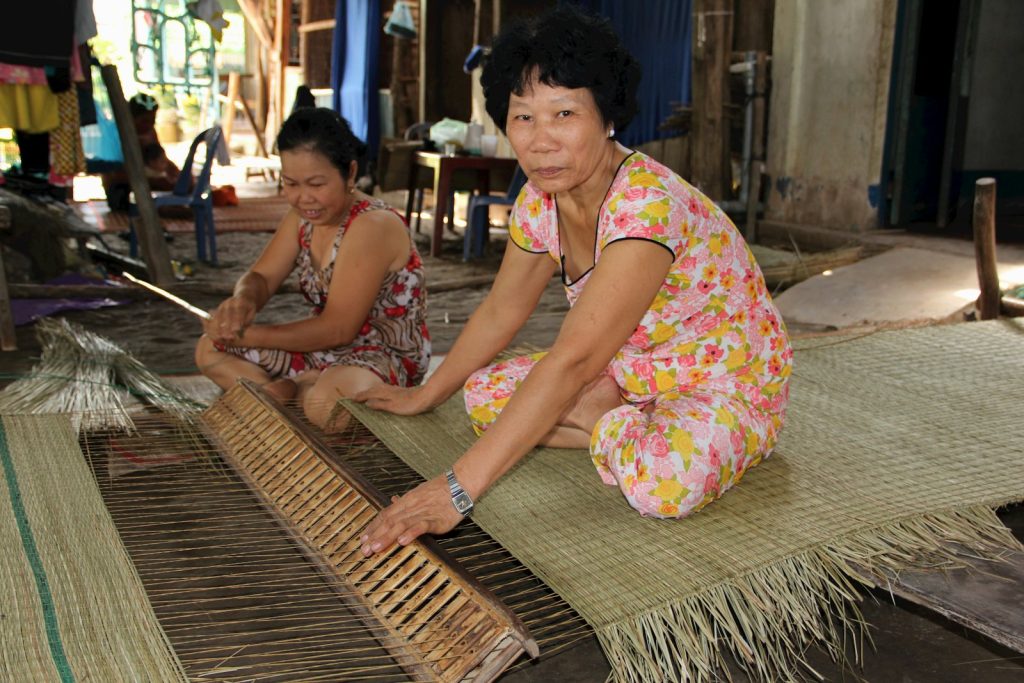
In Bali, many weavers work multi-technique on one piece (e.g. open lattice body with tight wicker top ring), while in Cirebon production is more segmented: specific teams only do lattice, others only do tight weave, for throughput and consistency.
Frames, finishing and wiring
Most exported rattan lamps are not entirely free-form. They sit on:
- Metal frames: Mild steel rod, powder-coated or painted to reduce rust. Essential for repeated reorders with consistent diameters.
- Bamboo or rattan frames: For softer, more organic shapes, especially for “Bali style” pendants and large woven domes.
Finishing options you’ll typically see offered:
- Natural/clear (light sanding, clear topcoat or oil).
- Washed (whitewash, greywash).
- Dark stain (coffee, walnut, or blackened finishes).
Wiring honesty:
- Most exporters offer E27, 220–240V wiring sets as standard for pendants and table lamps.
- CE-style kits are commonly available for EU/UK (by declaration and component sourcing), but you should verify compliance in your own market.
- UL/ETL certification is not standard in Bali or Java workshops. For North America, buyers typically:
- Order shade-only and add certified electrical components domestically, or
- Arrange UL-listed component supply and/or testing themselves.
For wholesale and OEM, we usually quote options as shade-only vs shade + basic wiring, with clear notes: CE feasible; UL/ETL to be managed by the buyer in their own jurisdiction.
Typical specs, HS codes and indicative FOB ranges (2024–2025)
The table below gives indicative working ranges our buyers use for planning. All are last verified June 2026 and must be confirmed by formal quote based on design, volume and finish.
| Item type | Typical size range (cm) | Primary material / weave | HS code (common use) | Indicative FOB range* (USD) | Typical MOQ |
|---|---|---|---|---|---|
| Rattan pendant shade | Ø25–60 x H25–60 | Rattan peel, open or lattice weave | 9405.49 / 4602.19 (by declaration) | ~US$6–22/shade | 50–100 pcs/size/finish |
| Oversized rattan pendant | Ø60–90 x H40–70 | Rattan/bamboo frame, open weave | 9405.49 | ~US$18–55/shade | 20–40 pcs/size |
| Table lampshade only | Ø20–40 x H18–30 | Tight wicker rattan or seagrass | 9405.49 / 4602.19 | ~US$4–14/pc | 100 pcs/mix of sizes |
| Rattan floor lamp (shade + base) | H120–160 | Rattan shade + metal/wood stand | 9405.29 | ~US$35–95/pc | 30–60 pcs/model |
| Wall sconce shade | W15–30 x H20–35 | Rattan or bamboo lattice | 9405.49 | ~US$5–16/pc | 80–150 pcs/model |
*FOB ranges approximate from Bali/Java ports, last verified June 2026, for standard designs and finishes. Final pricing always by quote.
For serious project or retail planning, you can plan your trip and prototype run with us; we coordinate via email and WhatsApp to align specs, packing and mixed-container loading before you visit.
MOQs, lead times and container loading from Bali/Java
MOQ logic: per size, per finish
Manufacturing constraints that drive MOQs for Bali vs Java rattan lamps:
- Frame jigs and set-up: New or non-standard shapes need jigs; cost only makes sense above a certain run size.
- Weaving pattern training: A new weave or shape takes time for artisans to master; stabilizing that learning over volume keeps unit costs workable.
- Finishing lines: Stain/paint batches are mixed in volumes; small runs see more waste and labor per piece.
As a working guide for mixed-order containers:
- Standard pendants: 50–100 pcs per size/finish is realistic.
- Large pendants (Ø70+): 20–40 pcs per size, often with combined MOQ across 1–2 finishes.
- Table lampshades: 100–200 pcs spread across 2–4 sizes of a family.
- OEM/custom shapes: Usually a higher first MOQ (e.g. 200–300 pcs total) to amortize development.
Lead times: development vs repeat orders
- Design development & sampling: 3–6 weeks including:
- Sketch/CAD confirmation,
- Sample weaving & adjustments,
- Finish tests and size verification.
- First bulk order after approval: Around 8–12 weeks ex-factory, depending on:
- Weave complexity (tight wicker is slower),
- Volume per SKU,
- Seasonal peaks (pre-Christmas, northern summer).
- Repeat runs of stable SKUs: Often 6–9 weeks, especially if frames and jigs already exist in Java workshops.
Container loading: how many rattan lamps actually fit?
Rattan and bamboo lighting is bulky but light. Effective loading depends heavily on nesting (smaller shades stacked inside larger). Typical planning ranges:
- 20ft container:
- Approx. 800–1,600 mixed pendant shades (Ø30–60 cm) if efficiently nested, or
- Approx. 400–700 pieces if a significant share is oversized (Ø70–90 cm).
- 40ft HC container:
- Approx. 1,800–3,200 mixed pendants, or
- Approx. 900–1,400 pieces with many oversized forms or floor lamps.
Buyers often mix pendants + table lampshades + small decor to use cubic capacity well. For serious planning we prepare a packing simulation with outer carton dimensions and estimated counts per container size.
Quality realities: handmade variance, moisture and mould risk
Handmade variance
All Cirebon and Bali rattan lighting is handwoven. Even with metal frames and QC checks, you should plan for:
- Dimensional tolerance: Commonly ±1–2 cm on diameter/height for larger pendants, and a few millimetres for small shades.
- Colour variation: Natural rattan shades vary from piece to piece; stains and washes help harmonise, but are not perfectly uniform.
- Weave tightness differences: Particularly on open and lattice weaves, as individual hand tension varies.
For hotel and retail chains, we usually align expectations upfront, adopt clear QC criteria (e.g. acceptable ovality/warp) and recommend an inspection regime.
Moisture and mould
Rattan is an organic material; humidity in both Indonesia and destination markets matters.
- In Indonesia:
- Raw cane is dried to reduce moisture content.
- Anti-mould treatments are often applied (by spray or dip) before weaving or finishing.
- Final goods are dried again before packing.
- In transit and storage:
- Containers can experience condensation, especially on winter routes.
- Desiccants and careful wrapping help but are not an absolute guarantee.
Practical points for importers:
- Specify anti-mould treatment in your PO if your market is humid.
- Avoid long, unventilated storage of sealed cartons on arrival.
- Plan a brief airing-out step before showroom display or dispatch.
Certifications, legality and “green” claims
Rattan and CITES
Most commercial rattan species used in Bali and Cirebon lamps are not currently CITES-listed. Customs documentation usually focuses on HS coding, country of origin and phytosanitary requirements, not CITES permits.
That said, regulations can shift; for any large or high-value program, confirm current requirements with your customs broker.
FSC/PEFC and “sustainable rattan” claims
There is a lot of marketing language around “eco” and “sustainable” rattan. A few realities:
- Certified material streams (FSC/PEFC) do exist in Indonesia but are not yet standard in all rattan lighting supply chains.
- If you require certified content, this should be a specific, pre-negotiated condition, backed by documentation and chain-of-custody checks.
- Absent that, rattan is still a fast-growing, renewable forest product, but we avoid blanket green claims.
We keep the focus on transparent sourcing and realistic expectations rather than headline-friendly labels.
Bali vs Java rattan lamps: how should buyers choose?
For most B2B buyers, the best answer to “Bali vs Java rattan lamps” is “both, in the right proportions”. The trade-off is less about geography and more about your needs.
- You prioritise custom design and frequent prototyping
- Working through Bali-based teams makes sense; they can iterate quickly, host you on-site, and coordinate with Java weavers once designs settle.
- You prioritise large volumes and cost efficiency
- Java (Cirebon and surrounds) should be your main production base, with Bali focusing on brand, sampling, and possibly final QC.
- You sell high-mix, low-volume assortments
- A Bali or Java consolidator who already aggregates multiple small-batch workshops is critical; be prepared for slightly higher unit costs in return for flexibility.
If you’re planning a sourcing trip to Indonesia, we generally suggest at least one factory or village visit in the Cirebon area plus time in Bali showrooms. You can plan your trip with us; we coordinate visits and sample reviews by email and WhatsApp so you use your time efficiently on the ground.
FAQs: where are Bali rattan lamps made and how does that affect importing?
Are “Bali rattan lamps” actually made in Bali?
Often they are only partially made in Bali. Many designs are developed, finished or assembled in Bali, but the main weaving is commonly done in Java, especially around Cirebon, using rattan sourced from other islands. For smaller orders and more artisanal pieces, you will find fully Bali-made lamps, but volume production is usually Java-based.
Is Cirebon rattan lighting cheaper than Bali-made lighting?
On a like-for-like design, Cirebon and other Java clusters often land at a lower FOB range because of labor structure, scale and proximity to ports. However, price also depends on weave complexity, frame material, finishing and your volumes. Design-intensive or highly curated collections developed in Bali can carry a premium regardless of where they are woven.
Can I request that my rattan lamps be 100% made in Bali?
Yes, but with constraints. Fully Bali-made rattan lamps are realistic for smaller programs, higher price points, and pieces with strong artisanal value. For large roll-outs across retail chains or hospitality groups, pure Bali production can struggle on both capacity and cost against Java-based weaving. Most buyers use a hybrid: Bali for design and QC, Java for main production.
What wiring certifications do Bali and Java workshops provide?
Standard exports typically include E27, 220–240V fittings, and many suppliers can align with CE-style requirements for EU/UK markets using compliant components. UL/ETL certification for North America is not usually provided by Indonesian workshops; importers either buy shade-only and add certified electrical sets in-market or manage certification through their own channels.
How do I start a wholesale or OEM project for rattan lighting?
Gather basic specs first: target sizes, weave style (open, lattice, tight), finish, indicative quantities and your main market. Then request indicative FOB ranges and MOQs, and, if necessary, a sampling plan. You can plan your trip or remote development with us; we handle RFQs, image/tech-pack reviews and ongoing updates via email and WhatsApp so your team has clear data before committing to tooling and volume.