Honest buyer note: Our lamps are handwoven by village artisans in Bali and Java, so expect natural colour variation and a size tolerance of roughly ±1–3 cm on larger shades. All prices, MOQs, lead times and container counts are indicative ranges (2024–2025, FOB Indonesia) and final pricing is by quote. Standard wiring is E27 at 220–240 V; we can supply CE-compliant wiring or shade-only (no electrics) so you meet UL/UKCA or local standards in your market — we don’t imply certification we don’t hold. Natural fibre is moisture-sensitive, so we dry, treat and pack appropriately and recommend acclimatisation on arrival. Rattan is generally not CITES-listed. We coordinate vetted workshops and handle export documentation.
Handmade color size variation rattan refers to the natural differences in shade, tone, and dimensions that appear from piece to piece in handwoven rattan lamps. For buyers focused on rattan lamp tolerance and handmade lamp consistency, accepting and managing this variation is the key to repeatable projects and fewer claims.
At Bali Rattan Lamps, my job is to be blunt about what is – and is not – realistically controllable in handmade natural-fiber lighting. This page is the reference I wish every buyer read before locking in specs on a large PO.
—
What “Handmade Color & Size Variation” Actually Means
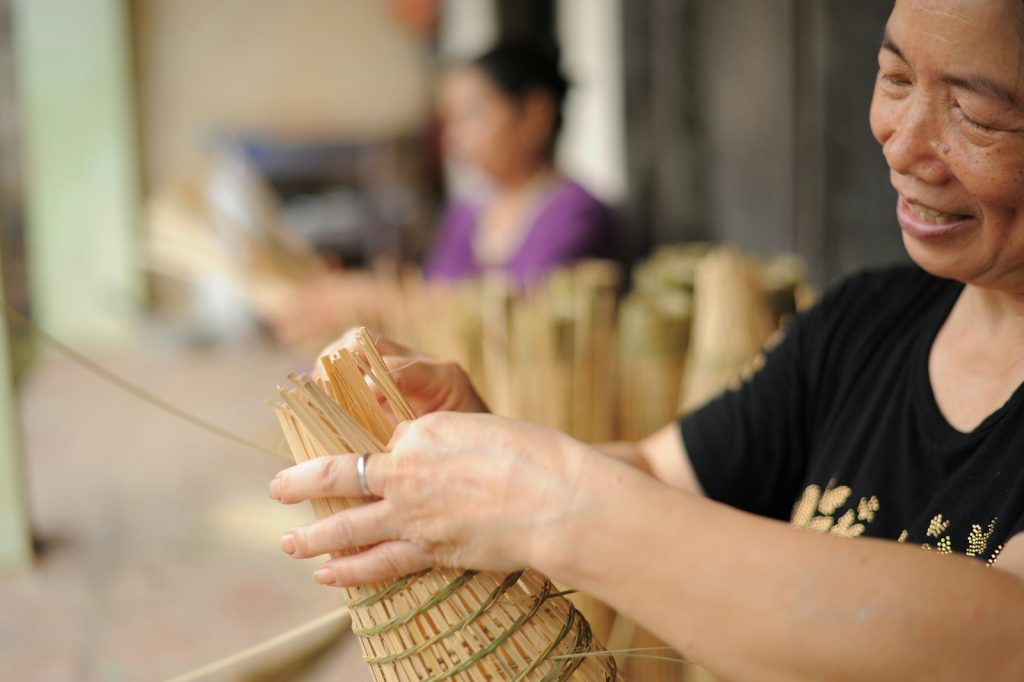
Handmade rattan lamps are built from a natural vine, processed in small batches, and woven by individual artisans. Three variation layers stack together:
1. Fiber variation
– Different rattan species and grades from Kalimantan and Sulawesi have slightly different base colors and densities.
– Oven drying tones vary by batch: one load may cure slightly warmer (more honey), another a bit cooler (straw/grey).
2. Finishing variation
– Clear or tinted topcoats soak differently into denser vs. more porous canes.
– Spray and hand-brush finishing on open-weave pendants is more exposed to light, airflow, and humidity changes during curing.
3. Handweaving variation
– Basketry and open-weave patterns are produced piece-by-piece, not from molds.
– Two artisans weaving the “same” Ø40 cm pendant can differ 0.5–1.5 cm simply from hand tension, especially on large diameters.
The right approach is not to demand “zero variation” but to define acceptable tolerances and QC checkpoints that respect the realities of handmade production.
—
Typical Size Tolerances in Handmade Rattan Lamps
For B2B buyers, the practical question is: “How much can these lamps differ from the spec and still be acceptable?”
Across our Bali and Cirebon facilities, under controlled production and QC, this is what we consistently see on shade-only and wired pieces:
Standard Size Tolerance Ranges
| Dimension | Typical Spec | Realistic Tolerance (Handmade) | Notes for Buyers |
|---|---|---|---|
| Diameter <= 30 cm | e.g. Ø25 cm | ±0.5–1.0 cm | Tighter control possible with simple weaves. |
| Diameter 31–60 cm | e.g. Ø40/50/60 cm pendants | ±1.0–1.5 cm | Most common category for hospitality projects. |
| Diameter 61–90 cm | e.g. “XL” clusters | ±1.5–2.5 cm | Larger forms amplify weaving tension differences. |
| Height <= 40 cm | Table shades, small pendants | ±0.5–1.0 cm | Height is usually more consistent than diameter. |
| Height 41–80 cm | Floor lamp shades, tall pendants | ±1.0–2.0 cm | Depends on frame rigidity (rattan vs. metal). |
| Overall Floor Lamp Height | e.g. 150–170 cm | ±1.5–3.0 cm | Multiple components stack tolerances. |
| Opening size (top/bottom) | e.g. Ø10/15/20 cm | ±0.5–1.0 cm | Relevant for diffusers and glass fit. |
These are typical ranges, not contractual promises. For projects that truly require narrower tolerance (for example, precisely aligned multi-lamp clusters), we can often tighten to the lower end of these bands by simplifying weaves or adding internal frames — with cost and lead-time implications.
—
Understanding Color Variation in Natural Rattan
Color variation is less about QC “failure” and more about honest material behavior. Even with good control, rattan shades are not like powder-coated metal.
Sources of Color Variation
1. Species & Origin
– We primarily use rattan from Kalimantan and Sulawesi, processed in Java (Cirebon) or Bali.
– Slight mineral and soil differences change the base tone from lot to lot – some batches start more golden, some more neutral.
2. Drying & Moisture Content
– Rattan is kiln or oven dried to safer moisture levels before weaving and finishing.
– Even at target moisture, minor differences in storage humidity can shift apparent color by a few percent (matte vs. slightly satin look).
3. Hand-Finished Coatings
– Clear PU or water-based topcoats over natural rattan are sprayed in thin films.
– Open-weave shades cure in rooms, not robotic lines, so air movement and temperature affect gloss and depth of color slightly.
4. Aging & Light Exposure
– Natural rattan will mellow and warm with UV exposure.
– A shade photographed day one at the factory will look slightly different installed six months later in a bright restaurant.
How Much Color Variation Is Normal?
For a large production run in the same color finish:
– Within a single batch (same weave team, same day, same topcoat mix):
– Expect minor shade shifting of roughly 5–10% on a visual scale — usually only visible side-by-side under the same light.
– Across multiple batches (repeat orders, or large POs split over weeks):
– Without a retained master sample and good reference photos, the drift can be more visible.
– With strict sample control, we still recommend buyers accept “family color”, not Pantone-level matching.
We handle color as a visual tolerance: “all pieces must fall within the approved range sample under 2700–3000K E27 warm white light.”
—
Setting Realistic Rattan Lamp Tolerances in Your Spec
If your spec says “exactly Ø50 cm, identical color, no variation”, you are implicitly asking for industrial molded plastic, not rattan. That doesn’t mean you must give up control; it means defining the right type of control.
1. Define “Range Samples”, Not One Perfect Unicorn
For significant projects, we recommend:
– Approving 2–3 physical samples per model, representing the lightest and darkest acceptable tones and the tightest and loosest acceptable weaves.
– Marking and storing those as range samples on both sides (ours and yours).
– Using photographs under warm-white E27 lamps as shared reference.
This way, both sides understand “handmade lamp consistency” as a band, not a single point.
2. Specify Tolerances Explicitly on the PO
Adding a simple line to your purchase order removes a lot of ambiguity:
– “Size tolerance: diameter ±1.5 cm, height ±1.0 cm.”
– “Color tolerance: within approved range sample under 2700–3000K warm white, no single piece outside the range.”
If you do not specify, we default to our internal QC ranges described above.
3. Match the Product Type to Your Risk Tolerance
Different constructions have different stability:
- Rattan on metal frames – better dimensional consistency, higher structural rigidity, slightly higher FOB and more weight in the container.
- Free-form all-rattan weaves – more organic, visually lighter, but higher size spread and more vulnerable to humidity swings.
- Tight closed weaves – more labor hours, but often more stable sizes than very open airy weaves.
If your project involves highly controlled alignments (e.g., linear clusters over a bar), we will likely suggest framed or partially framed solutions.
—
Moisture, Mould Risk & Why Storage Matters More Than You Think
Color and size variation in rattan is directly connected to moisture control. Oversimplified: the wetter the material, the less stable and more mold-prone it becomes.
Our Moisture & Mould-Control Practices
Across Bali and Cirebon production, we typically:
– Source raw rattan cores and peels from Kalimantan/Sulawesi, already pre-dried.
– Further dry and rest material before weaving.
– Perform additional oven/kiln drying of woven shades when required by season.
– Apply topcoats on material within acceptable moisture levels to minimize later movement.
– Store finished shades in ventilated, raised racking, never directly on damp floors.
Even with that, rattan is hygroscopic. It will absorb and release moisture on the ocean and at your warehouse.
Risk Points on the Journey
– In-container voyage:
– Containers can cross multiple climate zones between Indonesia and destination ports.
– If packing is too tight with no airflow and no desiccants, condensation can trigger mould spots.
– Cold climates / heated interiors:
– Arriving from tropical humidity to dry winter air, shades can contract slightly, changing tension and very marginally altering size.
We mitigate with controlled packing, desiccants, and pre-shipment checks. But zero risk is not realistic. Clear agreements on acceptable minor blemishes vs. rejectable mould are essential on large FCL orders.
—
Wiring, Certifications & How They Interact with Variation
Rattan shade variation interacts with wiring because socket positioning and drop length affect how variation is perceived once installed.
E27 Wiring, CE, UL & Shade-Only Options
Our standard production focus:
– Voltage: 220–240 V.
– Lampholders: E27 (most common for EU/UK and many other markets).
– Certification:
– We can supply wiring built to CE expectations for the EU/UK, with EU-style ceiling roses/canopies.
– For North America, most buyers choose shade-only and fit UL-listed kits domestically, or handle UL certification themselves.
– Shade-only:
– Often the best option if you want maximum flexibility on certification, dimming gear, or intelligent control systems.
Wiring & Tolerance on Pendant Length
Even though the main topic is color and size, for hanging pendants another tolerance matters:
– Cable length on wired pendants is typically controlled to ±2–3 cm over 1–3 m drops.
– If you need extremely precise suspended heights across long rows of pendants, we recommend:
– Shade-only, wired on site, or
– Generous cable length with on-site cut-and-fit, rather than trying to pre-cut exact lengths for each lamp.
Any minor shade height differences are usually visually masked when the installer adjusts final hanging height.
—
FOB Ranges, MOQs, Container Loading & HS Codes
You cannot discuss rattan lamp tolerance in a vacuum; price, MOQ, and packing also shift what level of control is practical.
Below are indicative 2024–2025 FOB Bali/Java by-quote ranges, not fixed prices. All quotes are project-specific and confirmed in writing.
Indicative FOB Ranges & MOQs (2024–2025)
- Small–Medium Rattan Pendants (Ø25–40 cm)
- Typical wholesale FOB range for shade-only designs: ~US$8–18 per piece, by-quote, assuming standard open weave, non-framed. MOQ often 50–100 pcs/model/color to keep weaving and finishing efficient.
- Medium–Large Pendants (Ø45–60 cm)
- Indicative FOB shade-only ranges: ~US$15–35 per piece by-quote, depending on weave complexity, with rattan-on-frame or complex patterns on the higher side. MOQ often 30–80 pcs/model/color.
- XL Pendants (> Ø70 cm)
- More labor, more packaging volume, more tolerance management. FOB shade-only can run from ~US$40–90 per piece by-quote for OEM/custom work. MOQs can be lower per model (20–40 pcs), but overall order volumes need to fill a decent portion of a container to be viable.
- Table & Floor Lamps (wired, E27, 220–240 V)
- FOB ranges widen because of frames, bases, wiring sets: approximate bands of ~US$20–70 per piece by-quote, with lamp bases, diffusers, and metalwork driving the upper range. MOQs typically from 30–80 pcs/model.
- Lead Times
- Production windows are often 6–10 weeks from deposit to ex-factory for standard models, longer for heavy customization or large consolidated shipments. Peak seasons and material availability can extend this; always confirm in the quote.
- HS Code (Typical)
- Most rattan lamp shades export under HS codes in the range commonly used for “lighting fittings” or “parts of lamps and lighting fittings” made from vegetable materials. The exact HS code and interpretation are confirmed case-by-case with your forwarder and customs broker.
Container Loading & How Variation Affects Packing
Approximate outcomes using standard export cartons and typical lamp nesting:
– A 20’ container can usually take a mixed load of a few hundred to 1,200+ rattan shades, depending heavily on diameters and how well models nest.
– A 40’ HQ can go into the low thousands, again pivoting on the ratio of XL pendants to smaller nesting pieces.
Important linkage to variation:
– Tighter tolerances and more rigid frames typically reduce nestability, meaning:
– More cartons for the same order quantity.
– Higher freight cost per unit.
– More flexible, free-form shades can often nest deeper, but result in slightly wider dimensional spreads.
We balance these trade-offs during sampling and packing tests. For serious projects, this is a good moment to plan your trip discussion via email or WhatsApp so we align on what matters most: tight tolerance, freight efficiency, or a compromise.
—
Handmade Lamp Consistency: What QC Can and Cannot Do
QC is not magic, but it is essential for managing realistic variation.
Multi-Stage QC for Rattan Lamps
Our typical sequence for export projects:
1. Incoming Material Check
– Visual grading of rattan, checking for excessive discoloration, cracking, or over-bending.
– Moisture awareness – flagging any loads that feel “green” for extra drying time.
2. In-Process Weaving QC
– First pieces from each weaver are checked against samples for weave density and form.
– Corrective feedback is given early; it’s cheaper than post-fact rejections.
3. Pre-Finishing Size & Form Check
– Random or 100% checks (depending on order size) of diameter, height, and roundness/straightness.
– Outliers above tolerance are either corrected (re-shaped) or culled.
4. Post-Finishing & Wiring QC
– Verification that topcoats are even, no major run marks, no visible foreign inclusions.
– For wired items: lamp holder type, polarity, basic function test, strain relief check.
5. Pre-Packing Color & Size Grouping
– Where possible, pieces are grouped by closest color and size for more even distribution in cartons.
– This doesn’t eliminate variation, but ensures your cartons don’t contain all the lightest or darkest pieces in one box.
6. Final Carton & Loading Audit
– Random re-measurement of pieces, carton labels cross-check, desiccant inclusion.
What QC Cannot Promise Honestly
– Zero dimensional variation across hundreds of pieces.
– Identical color shade between two POs produced months apart.
– No minor cosmetic features typical of natural rattan: tiny fiber “hairs”, subtle nodes, occasional color specks within the approved range.
Our approach is to make these realities visible upfront, not hide them in fine print.
—
How to Brief & Buy Rattan Lamps Without Surprises
If you are specifying handmade natural-fiber lamps for a hotel, restaurant chain, or retail brand, here are practical steps to reduce friction:
1. Start with an honest conversation, not a moodboard alone.
Share where these will be installed, expected volume, timing, and how strict your client is on symmetry and color.
2. Decide early: shade-only or wired, CE or UL path.
This affects dimensions (because of canopies and strain reliefs), packaging, and your certification responsibilities.
3. Approve a realistic sample set.
One “hero” sample is not enough. Approve range samples and document them.
4. Write tolerances on the PO.
Clarify diameter/height tolerances and color band acceptance in writing. It protects both sides.
5. Plan for spares and replacements.
For large projects, adding 3–5% spare shades is cheaper than urgent airfreight later.
If you have a project on your desk now, this is the right moment to plan your trip with our team – including WhatsApp calls to walk through drawings, specs, and tolerance questions in real time.
—
FAQs on Handmade Color & Size Variation in Rattan Lamps
Can you make rattan lamps with zero size tolerance?
No. With handwoven rattan, zero tolerance is not realistic. For most pendants between Ø30–60 cm, a well-managed production will sit around ±1–1.5 cm on key dimensions. If you require tighter, we look at adding internal frames, simplifying the weave, or adjusting the design, but we cannot honestly claim zero variation.
How do you handle color matching on repeat orders?
We keep retained range samples and finish recipes, and we photograph them under warm-white light for reference. On repeat POs, we match to those controls as closely as possible, but we still define acceptance as “within the approved color range,” not an exact Pantone. For critical projects, we may send a fresh pre-production sample for confirmation before mass production.
Does wiring (CE/UL) affect size or tolerance?
Wiring itself does not change the rattan weave size, but it adds components that increase total packed volume and weight. Ceiling canopies, strain reliefs, and cable routing can also influence how pendants hang and how any dimensional variation is perceived. For North America, most buyers choose shade-only and handle UL-listed components locally, which also decouples lamp tolerance from wiring approvals.
Is rattan subject to CITES or special export bans?
In general, the rattan species we use for lighting are not listed on CITES appendices. Export is handled under standard HS codes for lighting or related categories, with phytosanitary and fumigation treatments applied as required by destination market regulations. Specific compliance details are always confirmed by your forwarder and customs broker based on your country’s rules.
What happens if my delivered lamps are outside the agreed tolerances?
On serious B2B projects, we agree tolerances in advance. If a shipment demonstrably falls outside those ranges, we work case-by-case: photo and measurement evidence, sampling across cartons, and then solutions such as partial credit, replacement in a future shipment, or rework where feasible. Clear specs and realistic expectations up front are what minimize these issues.